
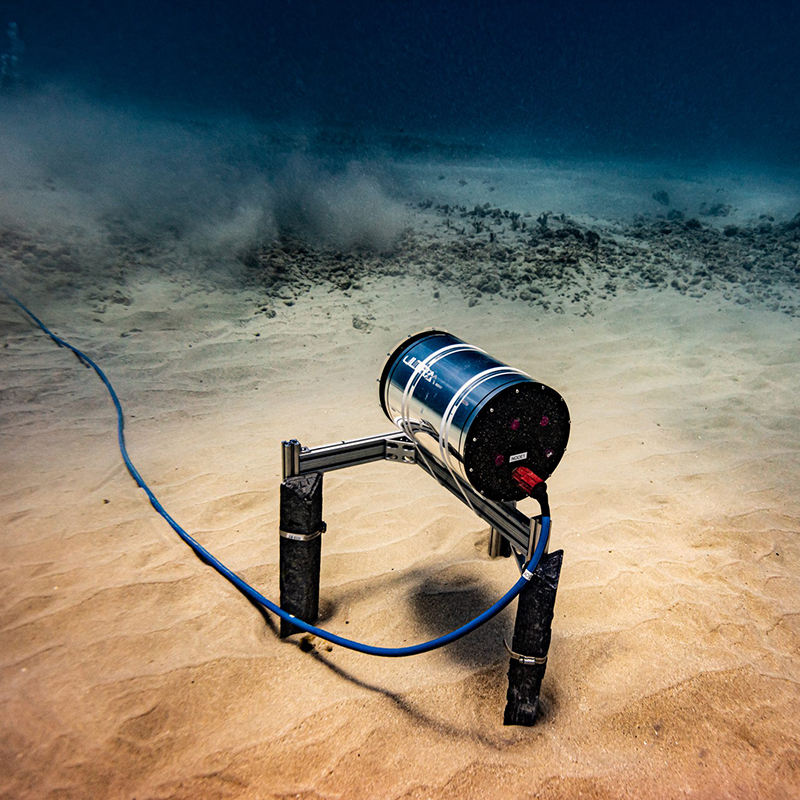
ULTRA (Underwater Laser Telecommunications and Remote Access) is high-speed wireless for the subsea Internet of Underwater Things (IoUT).

In partnership with...
Oceanit’s ULTRA was developed with support from the Shell GameChanger program and the U.S. Department of Energy’s National Energy Technology Laboratory (NETL).

01
Wired undersea infrastructure is fragile
Wired infrastructure have proven extremely costly to place and maintain in the subsea. And while acoustic communication is the most readily available technology for subsea communications, it interferes with marine life and delivers data at rates slowly. High-speed, long-range wireless communication has proven elusive due to the broadband absorption of all standard communication wavelengths. No single wireless technology is currently capable of serving as the backbone of a high-bandwidth subsea communications system without sacrificing range and data rates.

02
Laser technology travels more efficiently
ULTRA serves as the backbone of high-bandwidth subsea communications systems without sacrificing range or data rates. ULTRA uses point-to-point, tight-beam lasers to enable 100 Mbps bandwidth communications over distances of over 100 meters and runs through low-power sensor nodes, enabling real-time monitoring of wide-band data and eliminating the need for umbilicals. ULTRA has a much longer range than current systems and is unaffected by acoustic noise environments.

03
Why it matters
In subsea environments high-speed data transmission, continuous monitoring abilities, and high-capacity communication systems are becoming critical for operations in deep-sea environments for communication and infrastructure, in both the private sector and defense sector. The higher data rates made possible by the system will provide actionable information for multiple subsea use cases. ULTRA enables more efficient operations and situational awareness across a wide variety of subsea IoT devices.
ULTRA hero video
ULTRA revolutionizes the way information is transmitted underwater.
This high-speed data backbone will be critical for the Internet of Underwater Things (IoUT).


At a glance
Key features of ULTRA...
Gigabit bandwidth communications No umbilicals to distributed sensors Maintains high bandwidth at long ranges Unaffected by high acoustic noise environments Operable with ROVs/AUVs Low power-consumption sensor nodes Real-time monitoring of wide-band data