
By Patrick Sullivan, Ph.D., PE, Founder and CEO of Oceanit, and Paul Brewbaker, Ph.D., CBE, former Bank of Hawaiʻi Chief Economist and Principal of TZ Economics.
Summary
We come from different backgrounds and fields with decades of experience in Hawaiʻi and across the world, but what we have in common is that we deeply care about Hawaiʻi and agree that Hawaiʻi’s future is on a troubling trajectory. Unless Hawaiʻi takes note and acts, we fear that Hawaiʻi’s unique people, culture, environment, and way of life are at risk — the Hawaiʻi of the future may be unrecognizable. In simple terms, the economics of tourism and coal mining have much in common. Both exploit natural resources that are subject to global competition and commoditization. Although it’s easier to understand the long-term challenges of coal mining, the long-term challenges of tourism are more obscure. Hawaiʻi’s focus on tourism and its inability to diversify the economy are problematic. Hawaiʻi’s degrading per capita GDP, now 10 percentage points below the rest of the U.S., as well as outmigration and unaffordability should be setting off sirens across the State. This hollowing out of Hawaiʻi’s community risks creating a place for a few wealthy and many poor, under-employed, under-housed or homeless Hawaiʻi citizens. This paper attempts to bring attention to Hawaiʻi’s issues and offers a path to a future Hawaiʻi that prioritizes people, place, and culture.
Background
We endeavor to frame Hawaiʻi’s future challenges in terms of economics, subscribing to Paul Krugman’s (2008 Nobel Prize in Economics) definition of economics — it’s about people and what people do. Gross domestic product (GDP) represents a simple and reproducible measure of goods and services produced within geographic boundaries — the average value of citizen’s productivity. It’s a convenient metric of how well, or poorly, a community is doing. A high GDP reflects wealth creation, a low GDP reflects a community in distress. For many years, Hawaiʻi’s GDP exceeded the U.S. average. Today, Hawaiʻi’s GDP is 10 percentage points lower than the rest of the U.S. In absolute terms, Hawaiʻi real GDP is 15 percentage points below the path Hawaiʻi was on five years earlier when it matched U.S. performance. Human capital formation sounds like an esoteric concept. However, building and empowering people to think, solve problems and innovate produces economic benefits across the entire community. Creating, acquiring and expanding human capital – the number of competent, educated, and experienced people — increases the economy and grows GDP.
Each year, at the conclusion of Oceanit’s Summer Intern Program, all involved are reminded that Hawaiʻi produces top quality talent. Over the last 38 years, Oceanit has hosted over 700 paid interns, mostly University undergraduate and graduate students in STEM fields. Nearly all grew up in Hawaiʻi or have Hawaiʻi connections. Each summer the same truth is rediscovered — most bright young people don’t see their future in Hawaiʻi. By the time they finish high school and enter college they have been socialized to believe that there is no future for educated, knowledge workers in Hawaiʻi. This is tragic but sobering. When correlated with Oceanit’s ten-year experiment working with Hawaiʻi’s K-12 public schools, focusing on nearly 5,000 teachers and 200,000 students, where they were introduced to Design Thinking, computer science and artificial intelligence, and there was no observable change in outcomes, an important discovery was made. One could argue that this decade-long K-12 research project was a failure, however, one often learns more from failure than when things go as expected. When combining K-12 observations with over 700 intern experiences, it was concluded that Oceanit was working on the wrong problem. “The kids are all right,” per Pete Townshend, The Who: It’s the grownups that need to change. To impact Hawaiʻi’s future, one needs to move upstream to policy makers, elected officials, and business leaders.
Small, sometimes seemingly insignificant choices compound to produce significant impacts in the future — either foreclosing or opening up new vistas and opportunities. The consequence from years of small policy non-decisions, or poor policy decisions over time, can accumulate into consequential outcomes, either positive or negative. Although the individual impact of non-decisions may seem small, safe, or inconsequential, sometimes they accumulate to produce catastrophic impacts, as seen with the total destruction of Lahaina, Maui. Individually, any one choice to reduce risk, allocate water resources, utilize alarm sirens, etc. may have been of little consequence – but the combined impact and weight of many poor decisions acting in concert resulted in a catastrophic outcome. One could argue that the recent tragedy on Maui is a metaphor for the State of Hawaiʻi.
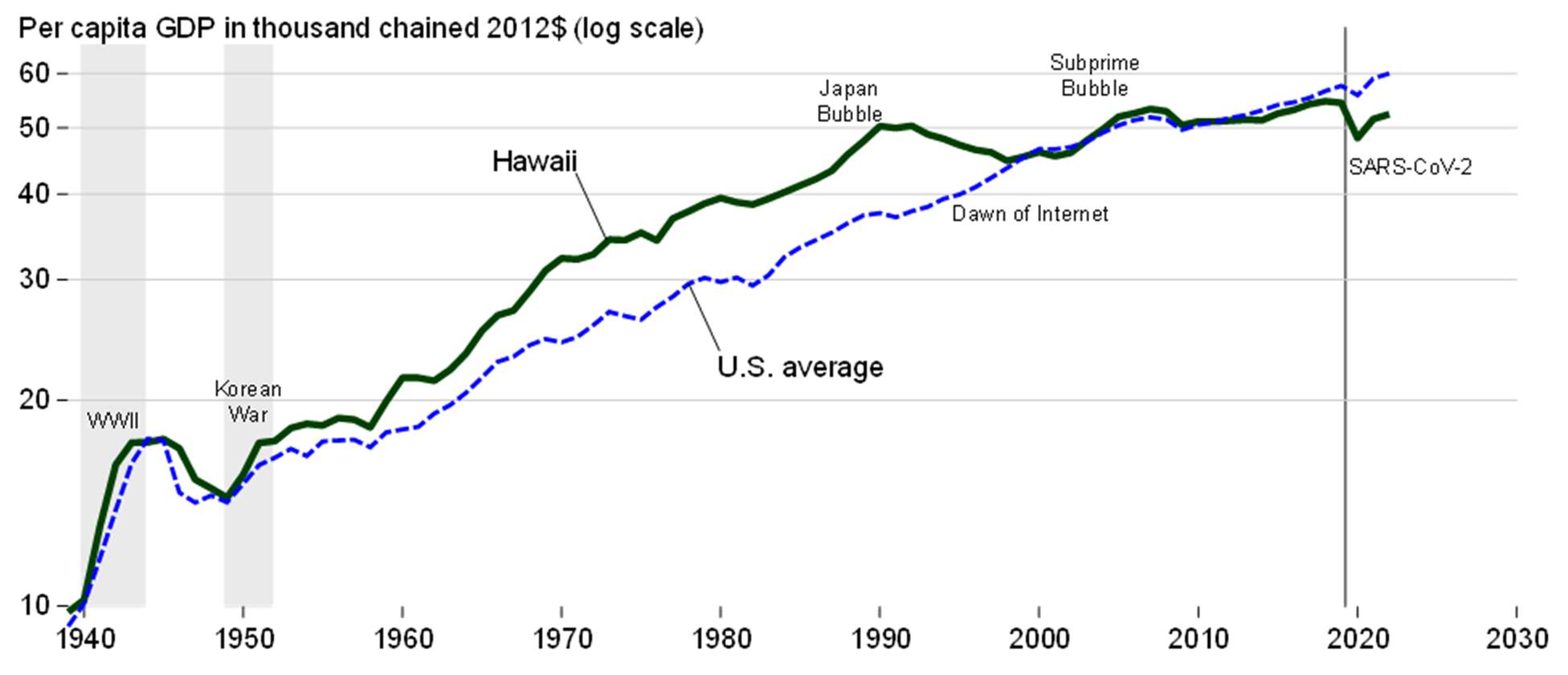
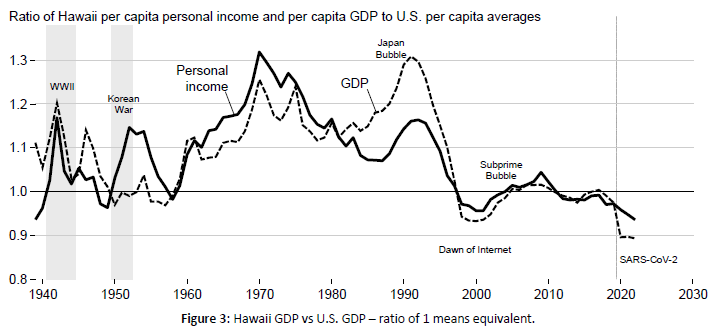
Hawaiʻi once was a place of big ideas, dreams and opportunities. Big ideas, supported by an imaginative and entrepreneurial community, informed big projects, for example: Aloha Stadium, the University of Hawaiʻi, the Natural Energy Laboratory on the Island of Hawaiʻi, global leadership in Astronomy. There was a time when Hawaiʻi state GDP per person exceeded the U.S. national GDP person, as shown in Figure 1. However, as a consequence from many choices over many years, Hawaiʻi GDP per capita has slumped to fall more than 10 percentage points below U.S. GDP. Although this is statistic may mean little to most, it represents increased inequality, more homelessness, residents leaving Hawaiʻi and a decreasing population. This didn’t just happen overnight – it took years, just as it will take years to alter Hawaiʻi’s economic future. However, the first step to changing Hawaiʻi’s economic future is to recognize the problem.
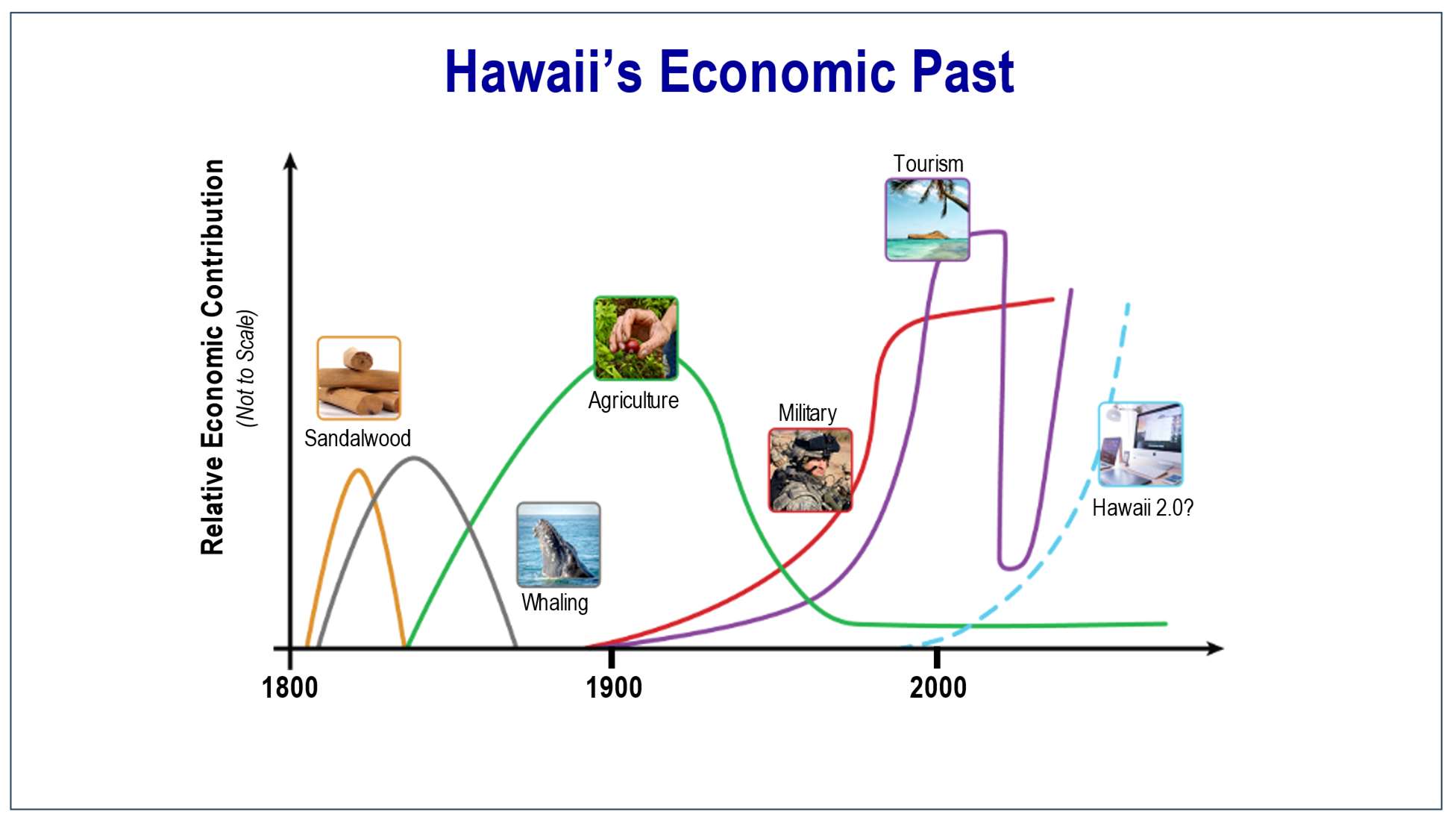
Hawaiʻi’s economy over the last two hundred years has seen ups and downs — from sandalwood to whale oil, to agriculture and tourism. Each time there was growth, eventual decline and a pivot to an alternative industry, as illustrated in Figure 2.
Because Hawaiʻi used to be comfortable with big ideas and entrepreneurism, lots happened in the post-war and early statehood era.
Until the last few decades, Hawaiʻi had competitive or even superior per capita GDP and personal income, relative to the U.S. per capita averages, as shown in Figure 3.
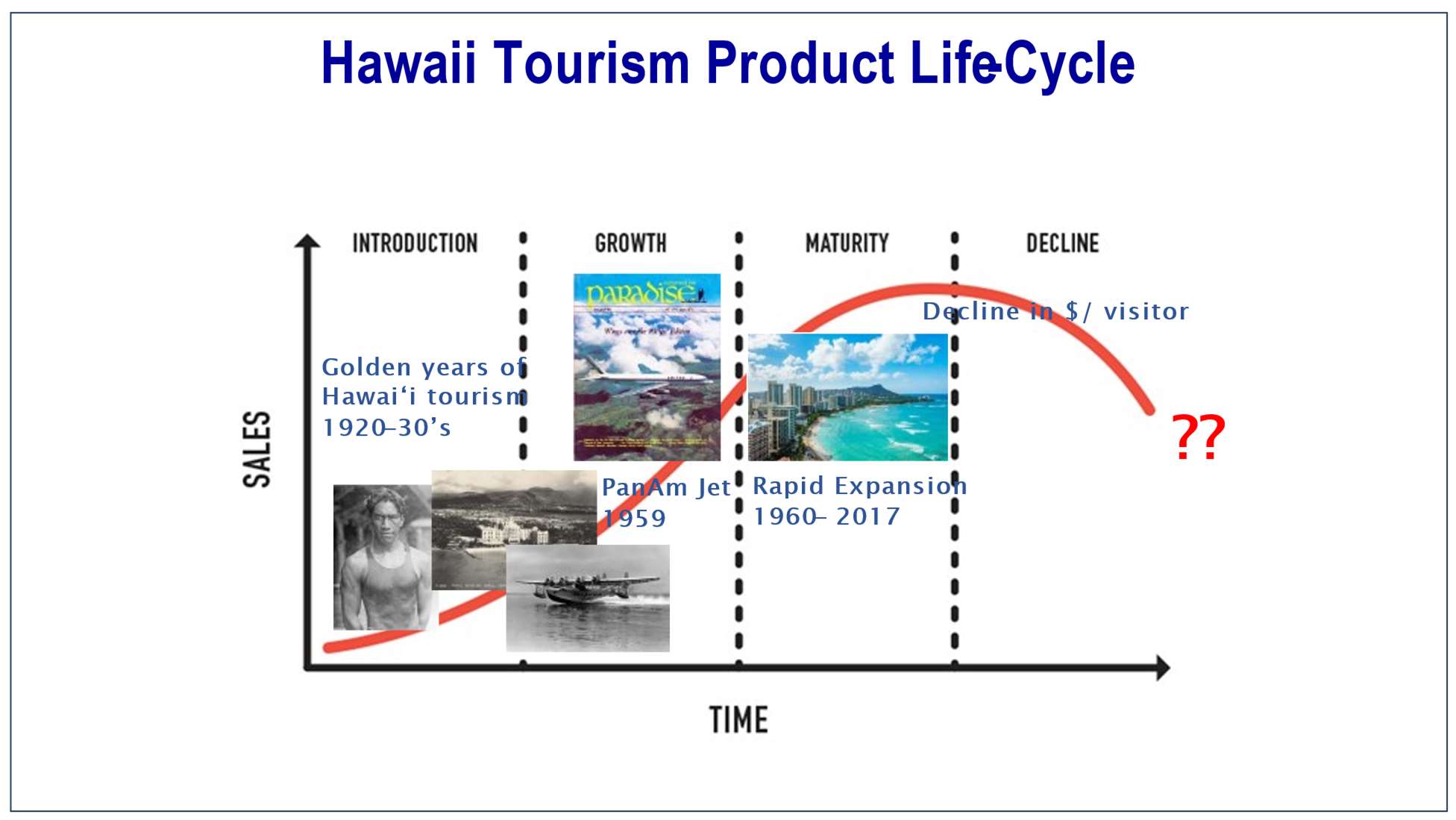
Hawaiʻi’s main export activity today, tourism experiences, is an interrelated complex of industries — transportation, accommodation, food services, retail distribution, etc. — based on comparative advantage rooted in Hawaiʻi’s natural and cultural endowment. Modern Hawaiʻi tourism originated in a technological innovation: transpacific commercial passenger aviation, with passenger jets coincident to statehood (1959), making Hawaiʻi a bona fide domestic destination. Until the 1990s, steady Hawaiʻi tourism export growth was enabled by human and physical capital formation. But since the 1990s, neither Hawaiʻi tourism receipts adjusted for inflation, nor Hawaiʻi tourism-based employment, nor Hawaiʻi’s lodging inventory have increased materially. All of the small net increase in Hawaiʻi lodging during the last quarter century occurred in vacation rentals, unleashed by smartphones and hosting apps. Hotel employment, pre-pandemic, was essentially the same as in 1990. Constant-dollar tourism receipts have never been higher in Hawaiʻi than in 1989. But policies throttling tourism growth for thirty years do not explain the failure of Hawaiʻi’s non-tourism economy to grow.
The economics of tourism and coal mining have much in common. Both exploit natural resources. Both are subject to global competition and the risk of commoditization as other geographies exploit similar resources. Both coal and tourism gave economic vitality to regions in need of jobs and opportunity. Coal mining produced significant environmental spillovers that were major contributors to global climate change. Whereas coal mining extracts a nonrenewable resource, Hawaiʻi tourism relies on renewable natural resources: Hawaiʻi’s natural beauty, its diverse people, and its host culture. However, renewable resources cannot be sustained without stewardship. Also, as with any activity in a small open economy, competition demands upgrading and refreshing tourism destination product offerings, while reducing costs of production and distribution. All product offerings are subject to life-cycle challenges, as illustrated in Figure 4. Global competition requires upgrading product offerings, efficient execution and delivery.
One half-century of nearly singular focus on tourism’s expansion, through the 1980s, followed by a generation of tourism throttling, to the neglect of human capital formation, has resulted in or exacerbated decreases in Hawaiʻi’s per capita GDP relative to the national norm. Neglecting the negative social and environmental spillovers of tourism aggravated declining per capita GDP once tourism exports effectively stopped growing after 1989. Even before that time — by the mid-1970s — risk-adjusted real tourism returns, which had risen steadily for one half century, came to an end. The challenges associated with tourism’s impact did not abate while volatility channeled through tourism persisted. Which is worse? High growth and high volatility, or no growth and high volatility?
For thirty years, Hawaiʻi tourism decreased as a share of GDP, from one-third of GDP in the 1980s to one-quarter of GDP by the turn of the century to one-sixth of GDP by the 2010s, compounding the consequences of declining per capita Hawaiʻi GDP over time. The result: amplified social and economic stress — increased inequality, unaffordable housing, missed economic growth opportunity, loss of population — losing the future. Perennial talk of economic “diversification” in Hawaiʻi is punctuated by tourism challenges, biological events like the COVID-19 pandemic, geopolitical events like 9/11, geophysical events like the Lahaina fires or Hurricane Iniki. Each time, the economic policy “diversification” conversation has ended with doubling-down on tourism. Then, during the last five years — before and after 2020 pandemic onset — Hawaiʻi simply went off-track. Hawaiʻi’s real GDP veered off a course it matched with the U.S. average during the mid-2010s, falling further below its path before 2020, and even after 2020 in pandemic recovery falling further below its 2010s path until 2023, as shown in Figure 5.
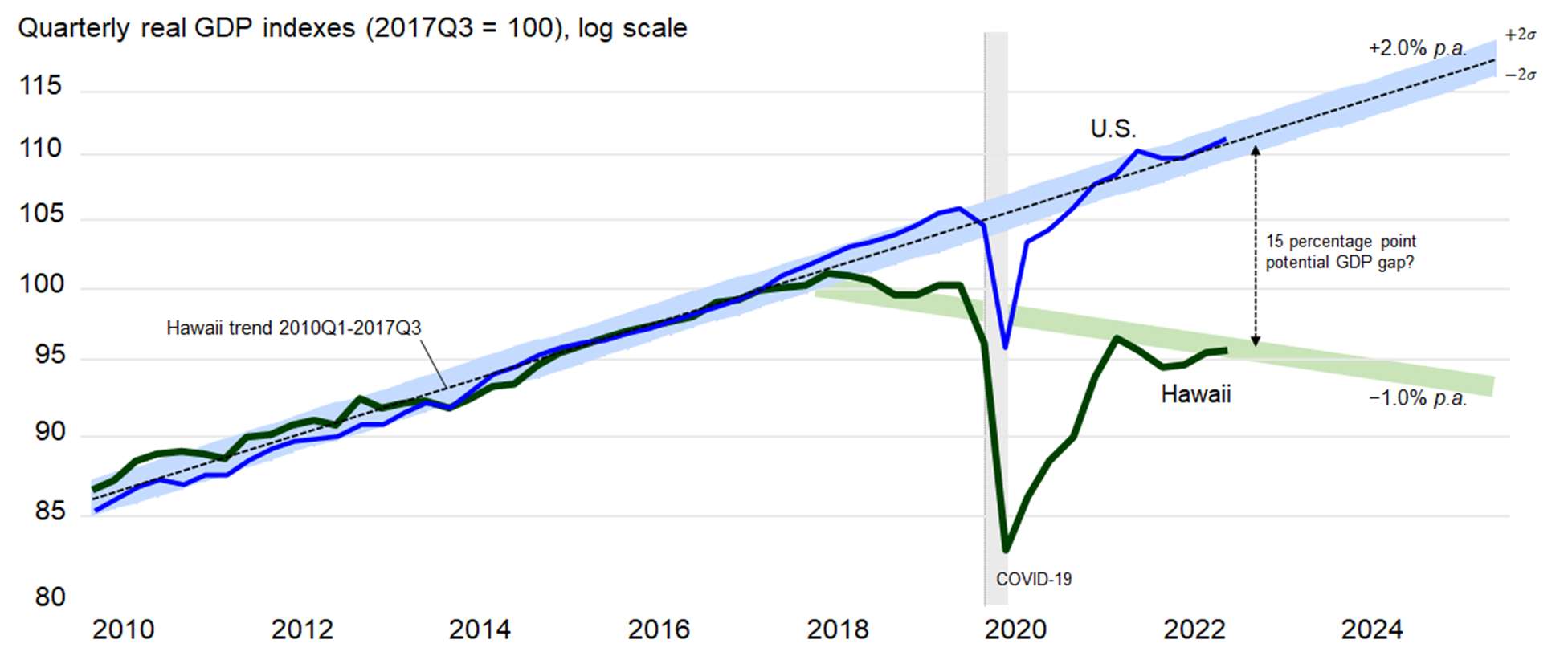
Even if we are able to get on track in 2023, matching U.S. real GDP growth, Hawaiʻi is still 10 percentage points lower in per capita GDP. In absolute terms, Hawaiʻi real GDP is 15 percentage points below the path Hawaiʻi was on five years earlier when it matched U.S. performance. Hawaiʻi’s weakening performance into the 2020s is uniquely a Hawaiʻi phenomenon, not a U.S. phenomenon.
Hawaiʻi has no chance of catching up, regardless of sustainable tourism, unless there are diverse economic growth opportunities. In today’s connected world where any geographic location with broadband, electricity and transportation can host knowledge workers, human capital formation can create these growth opportunities. However, human capital formation requires investments in education, research and development. The only thing preventing Hawaiʻi from economic growth is Hawaiʻi — its policy makers, business leaders and others in the community. Although most in Hawaiʻi recognize that the University of Hawaiʻi’s football team is important to the community, few fully appreciate that the future relies on the University of Hawaiʻi supporting research and investing in human capital formation — producing graduates, scientists, engineers and entrepreneurs, and creating knowledge. To make this happen will require a major shift in thinking about Hawaiʻi and its place in the world. Hawaiʻi has become comfortable exporting financial resources and importing expertise, but it needs to consider a 180-degree shift — exporting expertise, knowledge, and innovation, investing in human capital formation and knowledge creation, while tapping global financial resources.
Future Considerations and Recommendations
In this connected world, geography is less relevant to economic opportunity than ever before. This means that the consequence of policy decisions matter more if Hawaiʻi is to build a future to include opportunities for economic growth, good quality jobs and a more robust economy, one less dependent on tourism.
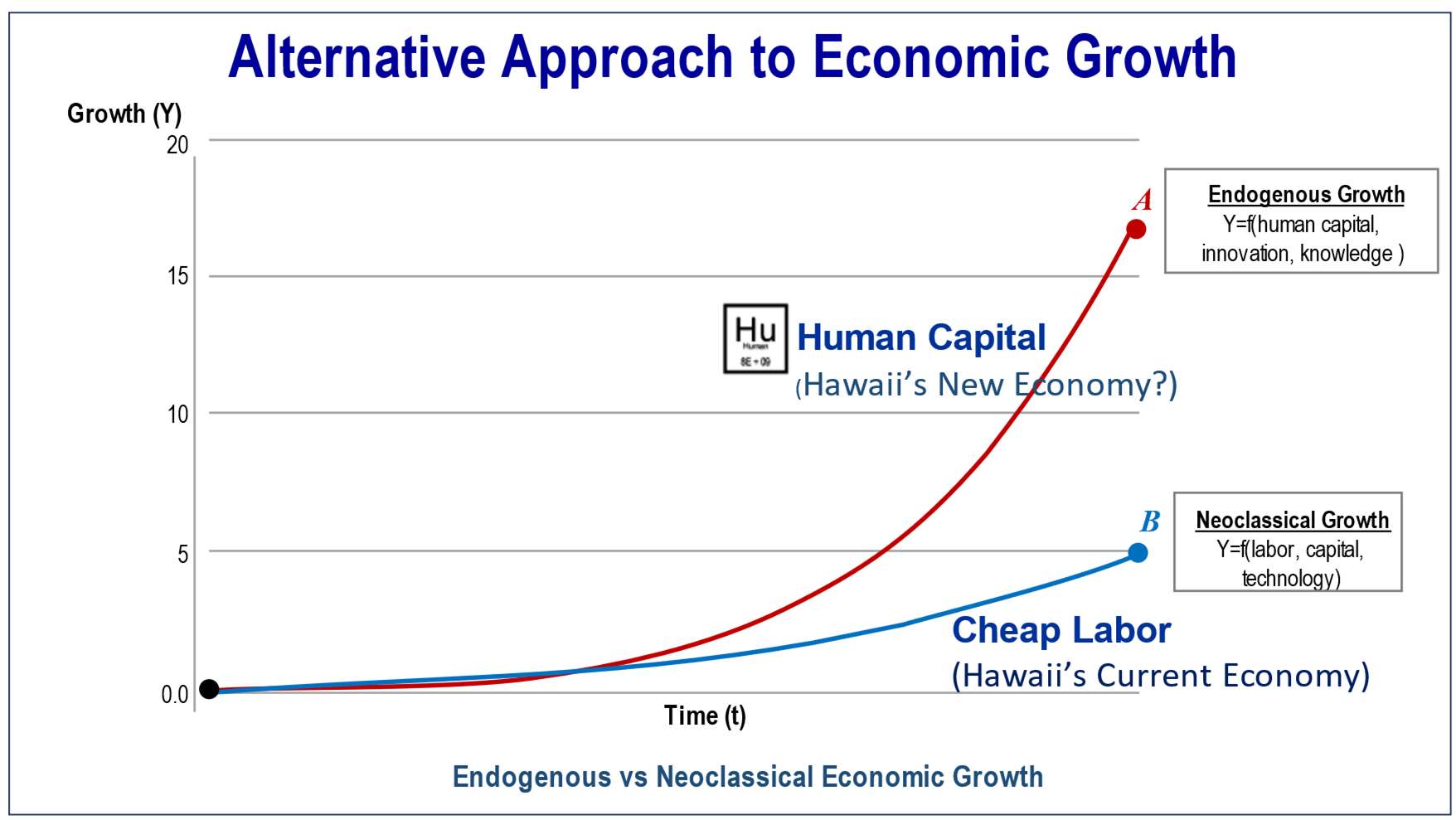
In a world where human capital creates future opportunity, investing in education and research is paramount. A key driver for growth should be the University of Hawaiʻi, which should be a haven for big aspirational ideas, aggressive STEM recruitment and investment. Preparing local kids to be part of the future requires that local K-12 schools share a version of the future that includes them — the kids. Legislative policies need to then support these ideas. Getting local kids into university-level education, from community college to graduate schools, is the path toward human capital formation. This model for economic growth, illustrated in Figure 6, referred to as “Endogenous Economic Growth” (Paul Romer, 2018 Nobel Prize in Economics), demonstrated that human capital dependent economic growth is primarily the result of internal forces, rather than external forces – in other words, it’s up to Hawaiʻi, not everybody else.
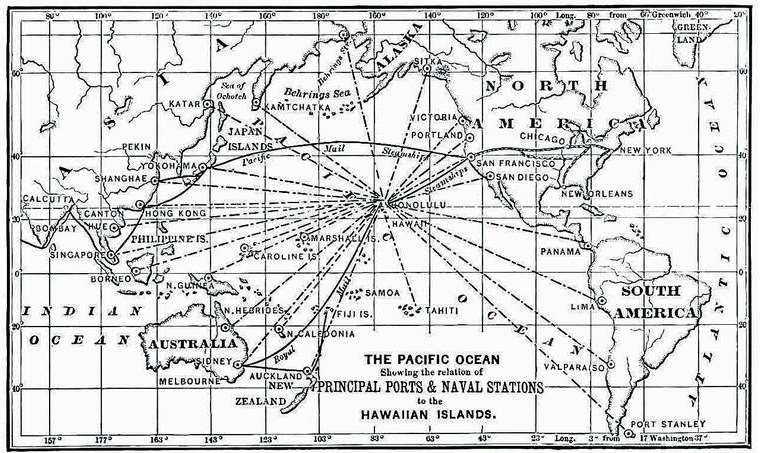
Creating coherent business policies for growing a knowledge economy would have a significant beneficial impact on future economic outcomes. Key infrastructure to defeating remnant geographic boundaries will require quality high-speed broadband, affordable electricity, and efficient and affordable transportation. All can be enhanced with suitable policies. Shifting mindsets to consider “from Hawaiʻi to the world,” rather than “from the world to Hawaiʻi, “would inform both Hawaiʻi and the global marketplace that Hawaiʻi’s knowledge economy addresses global opportunities – export knowledge and expertise, import financial resources. Ironically, this is not a new idea. As chronicled by Bob Siegel (September 8, 2023 Honolulu Advertiser), King Kalakaua’s tour of the U.S. in 1874 changed perspectives of Hawaiʻi with a simple map — that placed Hawaiʻi in the middle, central to the world, see Figure 7.
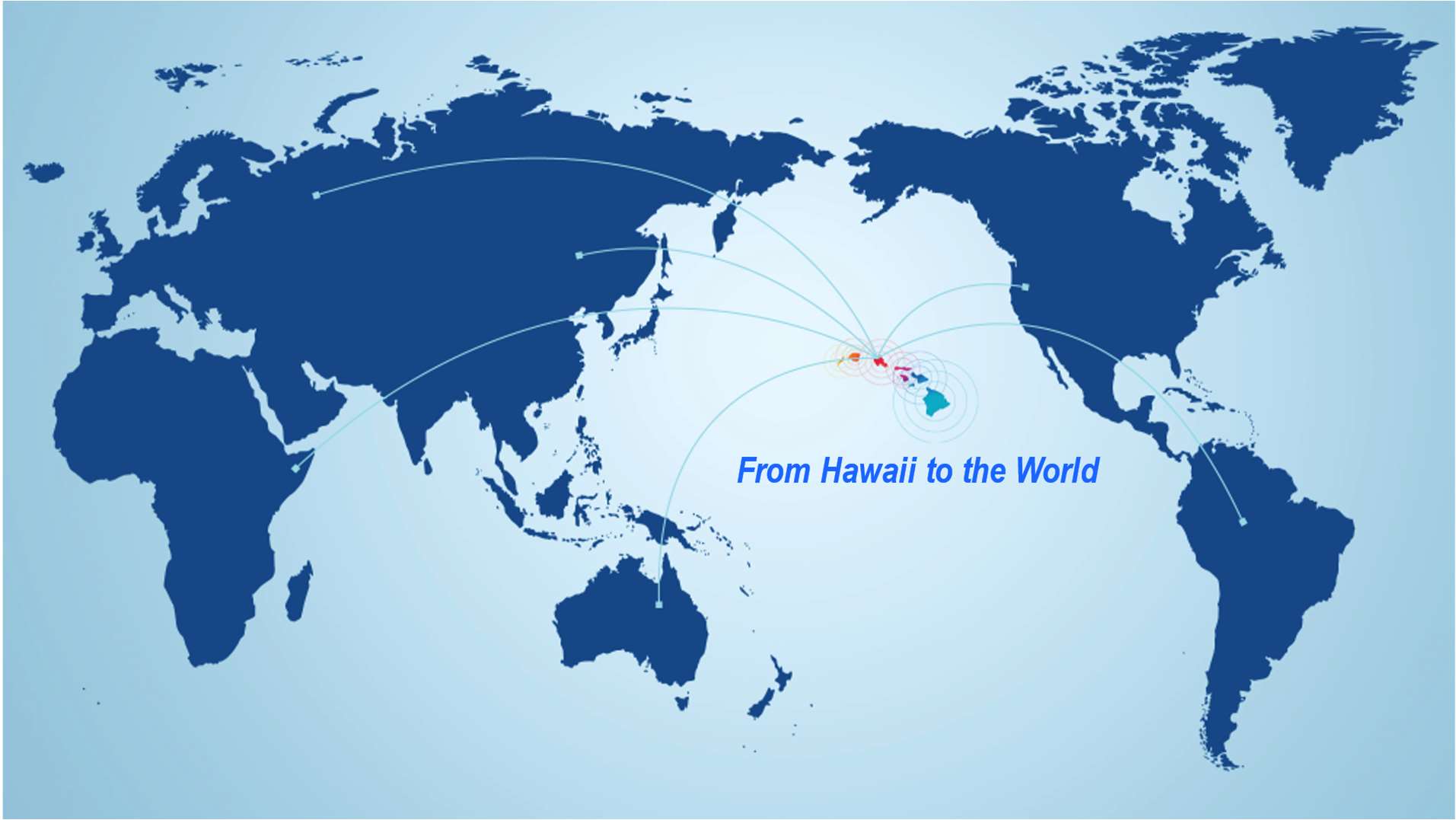
Whereas the leadership of King Kalakaua changed Hawaiʻi’s economic prospects by changing external mindsets in the late 1800’s, today Hawaiʻi’s biggest challenge is internal. Change needs to happen from the inside-out. Hawaiʻi needs to change mindsets, starting with community, business and political leadership adopting a perspective of “from Hawaiʻi to the world” — as shown in Figure 8, building human capital while exporting innovation, technology and ideas, while importing financial capital and resources to fuel economic growth.
To continue growing, Hawaiʻi needs to make the next transition, from a tourism economy to an innovation economy. This transition is one that has often proved difficult elsewhere. Although Hawaiʻi has become a world-famous visitor destination; it cannot keep growing by repeating the exercise. Doubling down on tourism has diminishing returns.
As optimists, we believe Hawaiʻi can craft a bright future. We have all the key ingredients for economic dynamism, including ethnic and cultural diversity, a great music scene, fabulous outdoor recreation, culture and the arts, surfing, nightlife and a great university, although often understated. Hawaiʻi has unique authenticity and great people — fearlessly competitive while kind and caring. It’s this authenticity that we should focus on, rather than trying to imitate other regions, like Silicon Valley.
Each year, interns at Oceanit are encouraged to “learn to get comfortable in your own skin.” What Hawaiʻi lacks is collective self-confidence and the political will to step into the future. The first step is recognizing we have a problem; the next step is believing we can do something about it to shape our future.
“Optimism is a strategy for making a better future. Because unless you believethat the future can be better, it’s unlikely you will step up and take responsibilityfor making it so. If you assume that there’s no hope, you guarantee that there willbe no hope.”- Noam Chomsky