
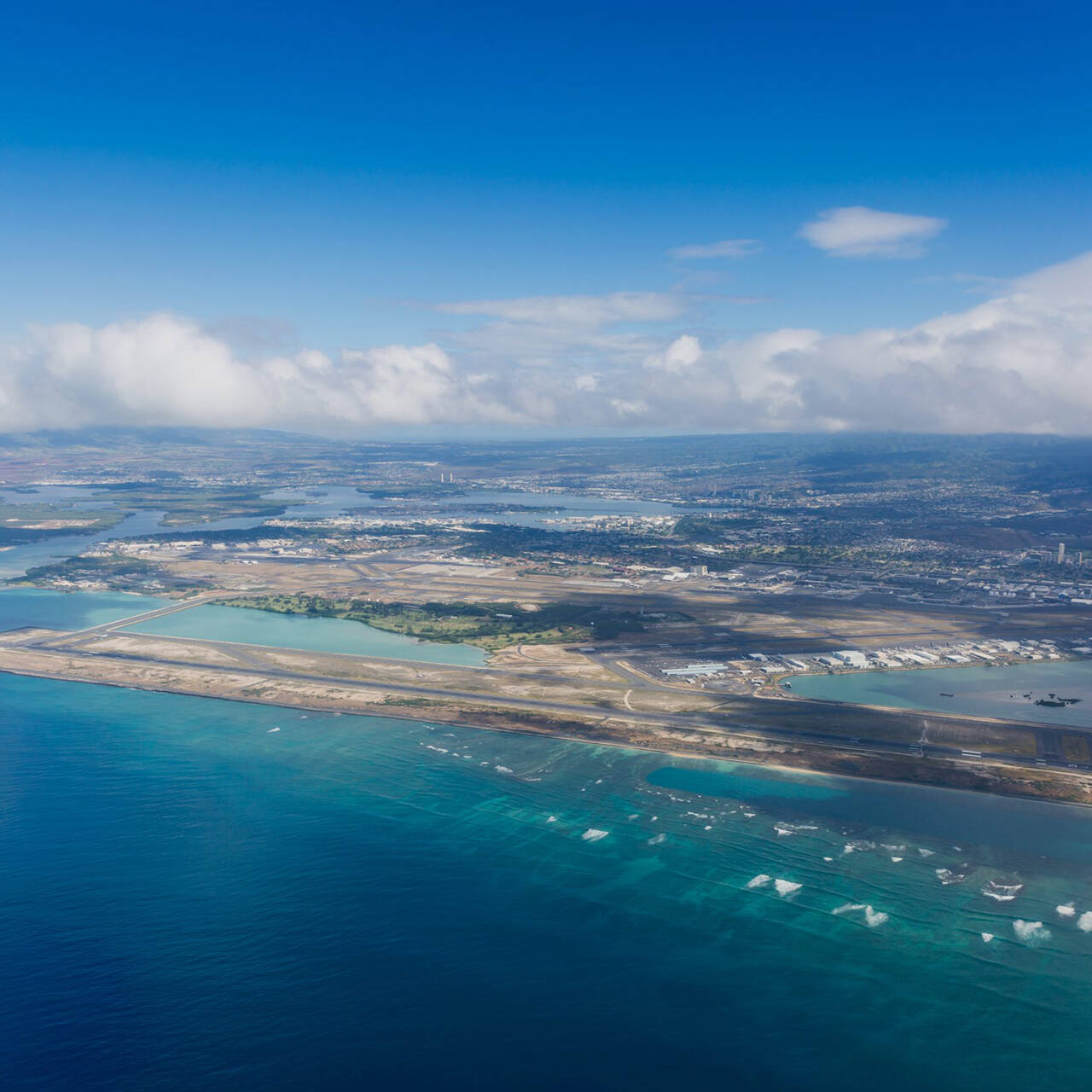
When the HNL airport flooded, Oceanit thoroughly examined every crack and found the source of leaking, which preserved airport operations.
Created in partnership with

Oceanit worked with the Department of Transportation – Airports and HNL to abate the water infiltration.
Other projects Oceanit has worked on for DOTA and HNL include asbestos abatement work in older terminal facilities, invasive mangrove removal from Ke’ehi Lagoon, boarding gate facial biometrics implementation, and providing new corrosion protected fences for HNL.
01
A slow leak interrupted airport operations
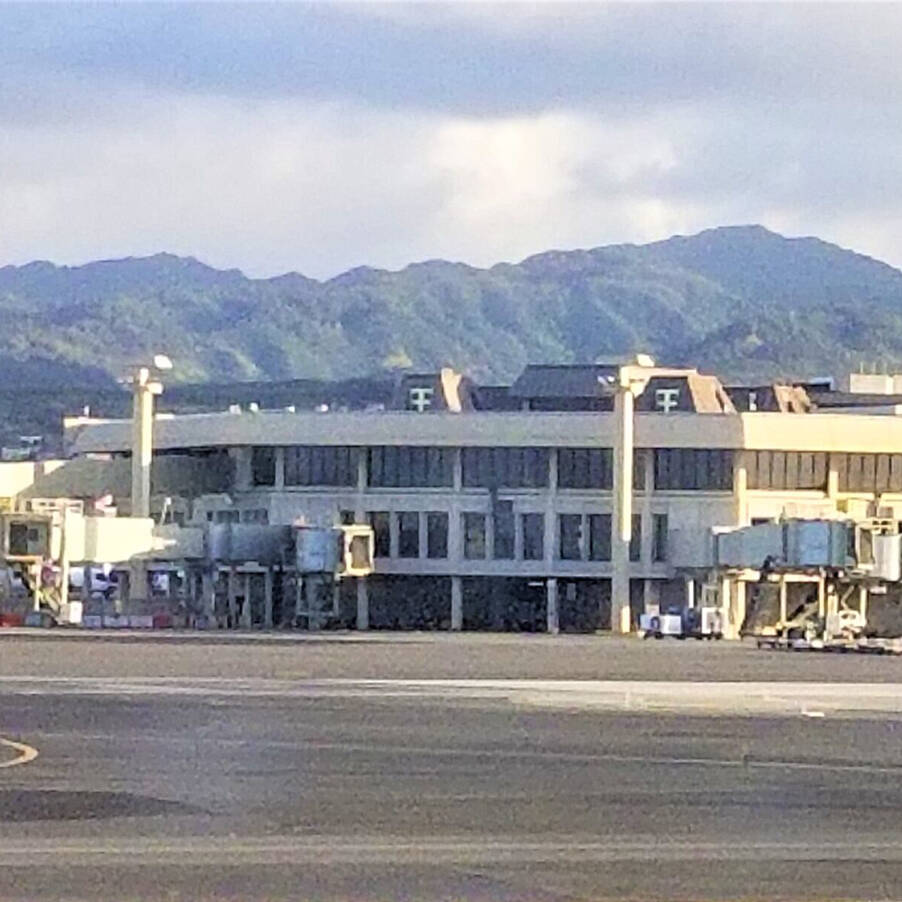
The basement level of the Daniel K. Inouye International Airport (HNL) is below the groundwater table, and for over 10 years, water infiltration and flooding was a persistent issue. HNL’s 360,000-square-foot basement was constructed in 1973 to accommodate an expanded baggage handling area. At the time the basement was built, a liner was installed to keep groundwater and sea water out.
In the years since 1973, leaking and flooding seeped in through drainage outlets and cracks in the concrete. The leaking basement had not significantly interfered with airport operations until 2017, when increases in flooded water levels significantly restricted the use of the north and south basement areas of the Overseas Terminal and International Arrivals Building (IAB).
02
Meticulously mapping every crack
To address this issue, Oceanit was contracted by the Hawaii Department of Transportation Airports Division (DOTA) to conduct a thorough investigation, provide engineering solutions, and offer design services to prevent flooding recurrence.
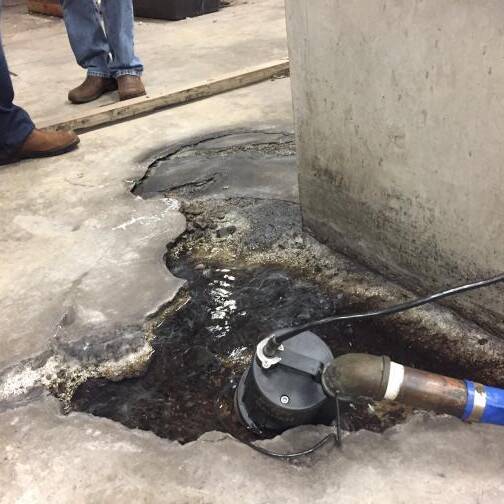
Oceanit meticulously surveyed and mapped all potential infiltration areas, including every crack in the basement, and discovered that the water came in through damaged areas in the basement waterproofing liner, and through the cracks in several floor slabs. The ground water was also coming in via a damaged and blocked floor drain system, which was originally installed to collect and dispose condensate water from the massive AC units that cooled the passenger terminal building above.
The Oceanit team also presented several conceptual engineering solutions, including filling in the existing floor drain system and redesigning it to be accessible for maintenance and repair, repairing and sealing damaged areas in the floor slab, and re-landscaping the area adjacent to the IAB walls to divert rainwater away from the building.
03
Why it matters
Oceanit’s comprehensive investigation into the water infiltration issue at HNL provided valuable insights and actionable solutions to mitigate the impact of groundwater inundation on the Overseas Terminal and International Arrivals Building basement. By addressing damaged waterproofing liners, cracks in floor slabs, and blocked drain systems, our proposed engineering solutions aim to restore functionality to these critical areas while also enhancing resilience against future water infiltration events at Hawaiʻi’s biggest airport.