Altino Intro C: June 8 - Hawaii PD Course | Introduction to the Principles of Programming
What: For 2021-22, we have six PDE3 teacher trainings scheduled for computer science. Learn to code and apply principles of computer science to your classroom.
Why: Computer Science (CS) is a 21st century career choice but more importantly CS is about learning how to think creatively and logically. Also, CS is required in every public high school in Hawaii starting in 2021-22 school year via Act 51. New legislation will bring computer science to elementary and middle schools by 2025.
Who: Designed for K-12 teachers to teach coding. DOE approved for 3 credits. Open statewide.
How: We kick off live online at 8:00am, but most of your training is via self-paced videos and online support from our Altino instructors.
Experience level: No prior computer science or coding experience required.
Size: only 30 teachers per training. Wait list for only 10.
Cost: $0, but if you register and are a “no show”, or you drop without a good reason, you may not be allowed to attend this training again. Based on 3 years of delivering this training, you should budget 50 to 75 hours to learn the materials and to complete your portfolio – three lessons with three student samples per lesson plan. This is a demanding training – if you are awarded 3 credits it’s because you earned it.
Sponsors: Public Schools of Hawaii Foundation, Kamehameha Schools, Oceanit Research Foundation, Toyota Hawaii, Department of Labor.
Contact: Brett Tanaka at OCID
Visit HIDOE's PDE3 website linked below and search 'Altino'.
Altino Scratch: June 3 - Hawaii PD Course | Introduction to the Principles of Programming
What: For 2021-22, we have six PDE3 teacher trainings scheduled for computer science. Learn to code and apply principles of computer science to your classroom.
Why: Computer Science (CS) is a 21st century career choice but more importantly CS is about learning how to think creatively and logically. Also, CS is required in every public high school in Hawaii starting in 2021-22 school year via Act 51. New legislation will bring computer science to elementary and middle schools by 2025.
Who: Designed for K-12 teachers to teach coding. DOE approved for 3 credits. Open statewide.
How: We kick off live online at 8:00am, but most of your training is via self-paced videos and online support from our Altino instructors.
Experience level: No prior computer science or coding experience required.
Size: only 30 teachers per training. Wait list for only 10.
Cost: $0, but if you register and are a “no show”, or you drop without a good reason, you may not be allowed to attend this training again. Based on 3 years of delivering this training, you should budget 50 to 75 hours to learn the materials and to complete your portfolio – three lessons with three student samples per lesson plan. This is a demanding training – if you are awarded 3 credits it’s because you earned it.
Sponsors: Public Schools of Hawaii Foundation, Kamehameha Schools, Oceanit Research Foundation, Toyota Hawaii, Department of Labor.
Contact: Brett Tanaka at OCID
Visit HIDOE's PDE3 website linked below and search 'Altino'.
IN THE NEWS | Oceanit News Update October 20th
Oceanit continues to earn local and national media coverage for our work during the ongoing global pandemic; both in direct response to our ASSURE-19 rapid saliva test development and on our efforts to help Hawai'i rebuild stability and sustainability in education, jobs, economic diversification, and more.
The Oceanit Research Foundation and SURF initiative have received wonderful feedback for the successful launch of https://www.altinocoding.com/. The website was launched with the help of our sponsors to offer our Altino Coding training program virtually and completely free. While schools and remote learning remain in a state of constant change during this unorthodox time, a usable platform for teachers and students makes sure that important computer science skills aren't falling to the wayside. Oceanit joined the CoronaMama Zoom Room show to speak about online learning using Altino, watch the episode here: https://bit.ly/2HvML9z
On October 8th, Hawaii Public Radio spoke about ASSURE-19 and how it could impact safe reopening in Hawaii, just one week before transpacific flights with quarantine exemptions would restart. For Hawaii residents, questions still lingered on how, when, and where inbound visitors would test for Covid-19 to ensure we keep our island safe. ASSURE-19, with its speed, convenience, and low cost, was at the forefront of many minds as a possible solution. You can listen to the show here: https://bit.ly/37pbzey

On October 16th, CEO Dr. Patrick Sullivan had a virtual conversation with Honolulu Star-Advertiser on their Spotlight Hawaii livestream show. He spoke about all-things-ASSURE-19, including time frame, FDA authorizations, costs, and keeping manufacturing in Hawai'i. Check both the video and the article at these links:
- Article synopsis- https://bit.ly/2IJEwYb
- Full video- https://bit.ly/3ji3GtB
Outside of the benefits of rapid regular Covid-19 testing, the economic potential of producing coronavirus tests in Hawai'i is unprecedented, especially with the current economic state. We truly feel that this could be a jumping off point for a new economic mindset in Hawai'i. Training workers, who may have been laid off due to the pandemic, in medical technology is one step in the long-discussed process of making Hawai'i a more self sufficient economy. Hawaii Business News discusses this economic reinvention in this October 19th article: https://bit.ly/2ThFwoE
We are moving quickly to complete ASSURE-19 data collection to meet FDA application standards and obtain emergency usage approval, which we expect to achieve in a matter weeks. FDA authorization is required in order for the ASSURE-19 tests to be used in a non-experimental setting and for results to be accepted by the state for travelers. The Star Advertiser discusses protective equipment and ASSURE-19 in an article, here: https://bit.ly/35jem6s
The University of Hawaii Shidler College of Business Alumni Association and the Travel Industry Management International, Inc hosted Dr. Patrick Sullivan ang with Lt Gov Josh Green and more Hawaii leaders for a webinar on supporting the re-opening of Hawaii’s tourism industry. A panel discussion on Re-opening Focused Health Safety Technology & Policy Innovation was published October 7th, and you can watch the live recording here:
https://www.youtube.com/watch?v=3VeLIGbadtg
Virtual Coding Training with Altino on Altinocoding.com
Oceanit believes that an innovative mindset starts with two things: education and imagination. Our SURF (Social Utilization of Resources for the Future) initiative began over ten years ago when we first adopted Design Thinking and began hosting DT workshops and trainings across Hawai’i to spread this method of problem solving. SURF grew over the years to encompass two more programs, Altino: Coding for Non-Coders and the Aloha AI network.
In 2020, our SURF initiative launched a free, online computer science resource for teachers, students, and parents: AltinoCoding.com. With education moving online and potentially being remote for the foreseeable future, the SURF initiative led by our very own Ian Kitajima, launched the new Altino Coding site on September 4th, to provide a virtual training center for our Altino Coding for Non-Coders curriculum.
This new online resource features a virtual version of the Altino Car that can be programmed to run code and “drive” on-screen. The SURF team created and recorded the first 20 virtual coding lessons for anyone who is interested to learn creative problem solving skills via coding at no cost, thanks to our sponsors. This new site is based on three years of Oceanit’s in-person Altino Training program, which to date has brought computer science professional development to around 600 K-12 teachers, at 131 public schools.
While in-person classes using the programmable Altino car were popular and engaging – learning while playing – we needed to find a way to ‘go remote’ during the challenges of the ongoing Covid-19 pandemic. So we built the new Altino Virtual Car! The top-down car drives like a video game: users write the command code and then have the virtual car drive those commands, all in a browser page.
To use Altino Online you will need a device like a smart phone, a tablet like an iPad, or a desktop computer; a web browser, and an Internet connection. The website and virtual car are friendly to most smart devices, making the platform accessible to even more learners than the original goal for the in person program. With the pandemic keeping many people at home, adults are now tasked with helping keiki learn virtually. Oceanit’s SURF Foundation developed the self-paced Altino programming video lessons and the hands-on virtual car to be entertaining and engaging for everyone; the programming classes are available to all parents, teachers, and students (either keiki, or just lifelong learners) free of charge to help keep education sustainable during the pandemic and beyond.
———————
A big mahalo to our sponsors for also seeing the vision- the Altino Virtual Car and classes are free of charge to all learners thanks to them, and without them, this would not be possible:
- Kamehameha Schools
- Public Schools of Hawaii Foundation
- Harold KL Castle Foundation
- Hawaii Dept of Education
- Dept of Labor and Industrial Relations (DLIR)
- Omidyar Foundation via HCF
- Servco Toyota Hawaii
- Hawaii State Legislature
PDE3 Learn 2 Code: Altino for Hawaii's Educational Professionals
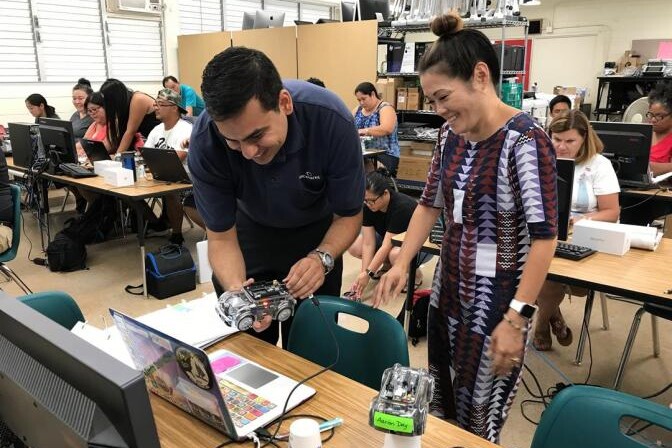
Since 2017, Oceanit has trained 555 teachers from almost 250 schools using the Altino coding system, creating a STEM education snowball effect to reach as many of Hawaii’s students as possible and setup a future of computer science understanding.
We continue this trend into 2020 by inviting more K-12 educational professionals to join us for a 3-day, DOE-accredited Altino course, generously funded by the Public Schools of Hawaii Foundation, Kamehameha Schools, and Toyota Hawaii.
Oceanit’s complex-based curriculum development is the hallmark of our training system; bringing together teachers from grades K-12 who are working in the same complex. This approach creates the opportunity for educators to develop a cohesive, comprehensive curriculum that can grow with students as they progress through grades and schools. The following complex dates and locations are scheduled Altino courses for 2020.
Setup for each class begins at 8:00 a.m. and the day ends at 3:30 p.m. No previous coding experience is needed to take advantage of the intro courses, but some experience may be necessary for ‘Advance’ courses. If none of the below dates and locations work for your educational group, SCHEDULE YOUR OWN – Find 3 days that work for your teachers and contact us via email here.
REGISTER: https://pde3.k12.hi.us
- March 16-18 Campbell Kapolei Complex Intro Coding PDE3
- March 19-21 Maui Complex Intro Coding PDE3
- June 3-5 Campbell Kapolei Complex Advance Coding PDE3 – online
- June 8-10 Statewide Scratch PDE3
- June 10-12 Maui Complex Advance Coding PDE3
- June 17-19 OPEN
- June 24-26 AMR Complex Intro 3 day/3 credit PDE3
- July 1-3 Leilehua Complex Intro 3 day/3 credit PDE3
- July 8-10 AMR Complex Advance 3 day/No Credit
- July 15-17 KMR Visual Block Coding (Scratch) PDE3
- July 22-24 (NEW DATE) Altino Statewide Advance PDE3
- Oct 12-14 Kauai Complex Intro 3 day/3 credit PDE3
- Oct 14-26 OPEN
Training Teachers with Altino Introduces Students to Creative Problem Solving & Uplifts Hawai’i
Present Frustrations
According to a 2016 study conducted by Aloha United Way, 48% of working families in Hawaii can’t afford to live to live in the islands. This is largely due to the high costs of living and low wages—Hawaii is consistently ranked as the most expensive state to live in, while 62% of jobs in Hawaii pay less than $20 per hour. A recent HUB report listed $93,000 for a family of four as low income in Hawaii.
As we come into the 21st century, however, Hawaii has the opportunity to write its trajectory. Between 2014-2024, computer science-related jobs are expected to grow by almost 11% in Hawaii—6% faster than the forecast for general job growth. And as of 2016, these types of jobs had a median hourly wage of almost $36—just about double the median wage for all jobs.
Whether our children are able to capitalize on this growth, however, will depend largely on their pursuit of higher education—particularly in computer and STEAM-related fields. As of 2017, there were roughly 1,400 unfilled computing positions but just 134 computer science graduates from the University of Hawaii.
Beyond computer science, in order to thrive in the coming decades, Hawaii needs to create other industries and companies that create higher-value products and services, and in turn, higher wages. This innovation-based economy will require us to teach our keiki to be creative problem solvers, able to spot opportunities others cannot yet see, overcome never-ending obstacles, and connect it all together across multiple disciplines to create game-changing solutions. We believe that this process starts in our classrooms. By exposing every student to coding in the classroom, we can create a pathway to developing creative critical thinkers with the potential to create their own innovative companies and careers and transform Hawaii’s economy.
Oceanit’s Solution: Altino
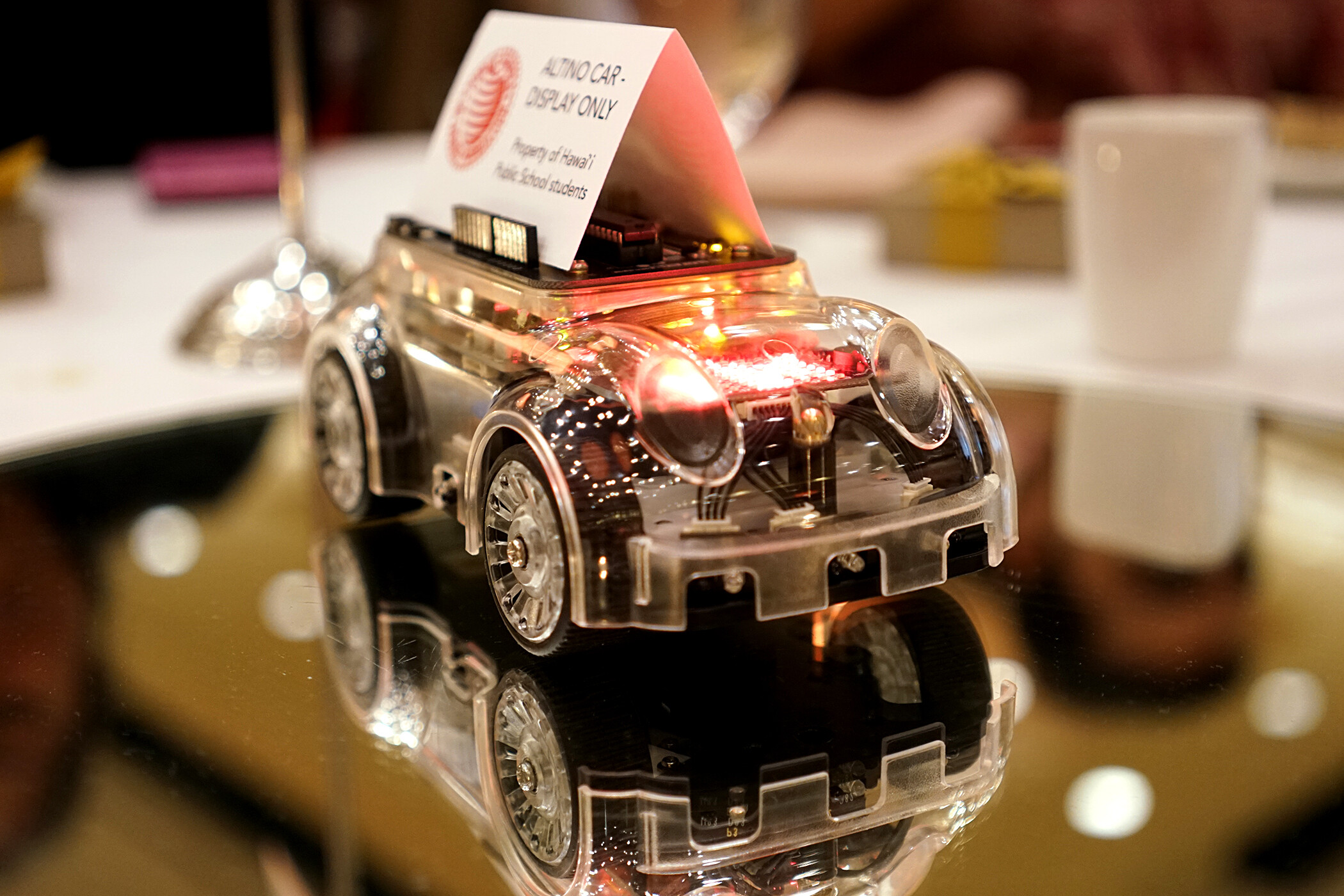
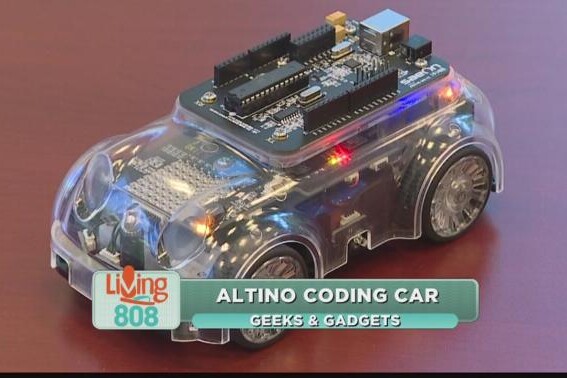
Altino is a small, programmable car developed by SaeOn, one of Oceanit’s partners in South Korea. Using Altino, Oceanit aims to train 5000 primary and secondary school teachers—across all subject areas from English to PE—how to code over the next 5 years. Teachers can then, in turn, instruct students to use Altino or incorporate other coding-derived principles into their curricula.
The Altino coding car allows non-technical teachers to learn the basics of coding in as little as two days. It can do a wide variety of different actions, including a fully autonomous mode using its six infrared sensors, and because there are no parts or pieces to reconfigure (in contrast with robots), 100% of the time is spent on problem solving and coding. The car has multiple sensors and capabilities to keep students engaged from K-12. When students go from elementary to middle and high school, they stay on the same Altino platform—no upgrades or additional equipment required. And as a result, the focus is on tougher coding challenges, learning new programming languages like Python, and doing thousands of Arduino open-source hardware projects.
Oceanit’s Altino training program is one of the only a few computer science training programs to be Department of Education-approved for three professional development credits for teachers. To earn this accreditation, training must meet the same academic demands as a university course.
Training Teachers Is Key to Consistent Exposure
Why train teachers—non-technical ones in particular? We designed our Altino training system to bring systemic change to education through a two-fold approach: first by teaching coding to more teachers, ensuring that students receive coding instruction in the classroom rather than as an elective or extra-curricular activity; and second, by helping teachers redesign existing subject areas like language arts and history to teach creative problem solving skills and increase the likelihood that students at any school can receive coding instruction during at least one class period every day. This addresses several of the largest hurdles that computer science education in Hawaii currently faces, namely a lack of computer science (CS) teachers and inaccessibility to most students.
Studies show that repeated exposure is key to getting students not just interested in but actually studying computer science in post-secondary education. And while exposure is the most critical element, experts argue that timing is also important—a younger student who still has more flexible thought processes will find it easier to think of coding as a tool rather than an obstacle and will normalize the process of breaking down larger problems into manageable, solvable pieces.
Our goal is to expose 100% of students in K-12 to coding, and the only way to scale up and achieve this cost-effectively is to train teachers. Given that elementary teachers reach about 25 students per year and middle and high school teachers reach around 100, on average, a single teacher reaches about 50 students per year. By training 5000 teachers, we have the potential to reach 250,000 students—when Hawaii’s K-12 population is a little more than 180,000.
Immediate Impacts
In 2018, Governor Ige signed two bills into law in support of computer science education. Acts 51 and 168 require Hawaii’s Department of Education to develop and implement a statewide computer science curricula plan for public school students in K-12 and ensure that each public high school offers at least one computer science course each school year by the 2021-2022 school year.
While schools and teachers are enthusiastic about being able to offer more students the opportunity to learn this increasingly vital skill, because of the short timeline, there is also the concern of whether it can be done effectively from the start. Our Altino teacher training program is a direct answer to this challenge. It is accredited, proven, and trains current teachers—meaning schools don’t have to hire staff for just one or two classes or compromise funding for other programs.
Successes to Date
- Increasing Reach Every Year: Since 2017, Oceanit has conducted several successful workshops for teachers on every island, training a total of 555 educators from 249 schools, who have the potential to reach up to 27,750 students.
- Complex-Based Curriculum Development: One of the hallmarks of our training system is that it brings together teachers from grades K-12, who are working in the same complex. This creates the opportunity for educators to develop a cohesive, comprehensive curriculum that can grow with students as they progress through school. One-third of our training program is dedicated to curriculum development, and teachers who have gone through our program have designed innovative curricula that blend coding with subject areas like history, music, automotive, construction, and health.
- Education-Focused Partnerships Extend Our Reach: Our partners include Kamehameha Schools, the Public Schools of Hawaii Foundation, the Department of Education, the Department of Labor & Industrial Relations, the Harold K.L. Castle Foundation, Toyota Hawaii, and the Hawaii Community Foundation (Omidyar Fund).
- Taking Altino Beyond Schools: Aside from working with teachers, Altino has also been used in a program we call “Code 4 a Future,” implemented at Halawa Correctional Facility. The inaugural class in May 2017 consisted of a mix of prison education staff and inmates that met every Friday afternoon over the course of 12 weeks. As of October 2018, 80 inmates have gone through either a basic or intermediate coding course with an additional 100 expected to receive training by the end of 2019.
Visions for the Future
Looking forward, Oceanit believes that the Altino training program can alter the future of Hawaii by creating generations of creative problem solvers. Over the next five years, we hope to be able to expose every student in Hawaii to creative problem-solving via computer programming, becoming the first state in the country to have statewide exposure. This, in turn, may open new career pathways for our children and our state. While computer programming is still largely considered a white-collar profession, there is a growing demand for blue-collar coders capable of maintaining code for a corporate website or government system, for example. This opens lucrative pathways for those who might not want or be able to pursue a four-year degree, further broadening the job prospects for our soon to be coding-capable youth.
The Truth About Altino
It’s not all about training coders. Altino is about inspiring the next generation of innovators, problem solvers, and technologists, and about creating a technology workforce in Hawai’i.
Research and developments in science often die in a laboratory without practical applications, but once a scientific breakthrough can be applied to solve a real-world problem, that’s where the magic happens. It’s gratifying to see the our work impacting so many different industries, but our most meaningful development work has been done with Hawaii’s educational community. At Oceanit, we are privileged to work closely with the students, teachers, and groups from across our community, and Altino cars have been a big part of our involvement in the past several years.
Our hope is to reach 5000 teachers by 2022 and work with them on computer science skills that can be built into our state’s classrooms and lesson plans. The ripple effect will be to reach all of our students with not only CS skills, but problem solving and critical thinking skills. Altino builds those skills through a haptic prop: a car. Everyone knows how a car should drive, steer, and accelerate, and beucase of this ubiquitous understanding, we have an opportunity to show how coding can be used as a language of problem solving.
Oceanit has reached hundreds of teachers over the past couple years as we have taken Altino on the road to complexes around the state. This also means we receive truly meaningful feedback, proving we are helping make a significant impact. This real, honest feedback from one of our trusted educational partners is one such commentary.
My thoughts about using Altino Cars
Sept 2019
By D.S., Librarian, Salt Lake Elementary
Giving students the opportunity to work with the Altino Cars goes way beyond just coding and programming. I have seen firsthand how all the other kinds of learning becomes a part of their process. First of all, it’s important to state that the capabilities of these cars enables a range of learners to be exposed to the world of coding and programming – from the beginning programmer to high school and maybe even beyond. The real life applications are only limited by the mind of the person designing/structuring the learning.
Students have to use math skills to convert parameters and when we asked students how they came to their answers, we found they came to their answers in different ways – promoting flexibility in how they manipulate numbers.
Most importantly, programming with these cars have really forced our students to develop a growth mindset simply because the cars are so highly engaging. All too often in education, we don’t want to see our students struggle and become frustrated so we don’t allow them to experience that feeling and learn what it’s like to push through and feel accomplished. Yet, we expect them to learn perseverance, persistence and develop grit. Those things cannot be developed if learning opportunities are not designed to let them struggle a little. It’s a beautiful thing to watch kids become frustrated or challenged but persevere because they know that is the only way they can get to what they desire, which is to test it out with the car. And it becomes even more impactful when they realize they can do it. It just may take numerous tries. It teaches them there really is no such thing as failure. “Failure” is just getting them that much closer to being successful. Our kids have had to learn to work with others, compromise their thinking sometimes, communicate with others and very importantly to be deliberate and precise. They have to solve a problem which is what I feel is at the core of coding and programming in real life. I’ve talked to them about where we see coding and programming in real life but they just see the end results. This is teaching them what’s behind it and what had to be done to “get there.” Someone had to code/program it. Someone had to observe or communicate with others to develop it. Someone had to discover there was a problem or think that something could be done better or more efficiently. Allowing students the opportunity to work with these cars have really opened their eyes to the world of programming but more importantly have taught them other things that will carry over into everything they do in the real world in order to be successful at life. I live to witness these moments. It is why I became an educator.
If you want to learn more about the Altino program or about summer Altino Training cohorts for teachers, which earn PDE3 credits, please click here.
IN THE NEWS | Sumil Thapa Named to PBN’s 2019 40 Under 40
Each year, Pacific Business News honors 40 of Hawaii’s outstanding entrepreneurs and business leaders by naming their 40 Under 40 Awards list. The honorees for 2019 are recognized at PBN’s awards event at the Sheraton Waikiki in early June. This year, Sumil Thapa was selected for his dedication to company and community, where he has led and contributed to efforts promoting science and materials engineering along with putting Hawai’i on the map for worldwide innovation.
In the past, he has been involved with work focusing on improving performance characteristics of polymer composites used on sea vessel exteriors. He extensively participates on many of Oceanit’s keystone efforts, including novel nanoparticle applications such as piezoelectrics, biologically active materials, fuel cell membranes, and most recently high performance drying material.
Currently, he is applying his knowledge in scale up manufacturing to oversee the construction of a pilot scale electrospinning system that will enable manufacturing of larger quantities of electrospun material. He also has been trained in the Design Thinking (user centric design) process by Stanford design instructors and has applied this training for efforts such as the development of a thermoelectric generator. Not only is Sumil Thapa an innovator in his professional life, he leads the way in impacting our community and giving back to Hawaii’s Keiki. Being a local boy fortunate to have the opportunities that lead to a career in technology, he is driven to share his experience and knowledge help inspire the next generation of innovators.
Mr. Thapa received his M.S. degree in Biological Engineering from University of Hawaii (2013) and B.S. degree in Chemical Engineering from Stanford University (2010). His academic background is focused on the areas of chemical engineering, chemistry, materials science, and bioprocessing. His research experience centers around polymer coatings, polymer composites, and nanomaterials for various applications including self-healing and corrosion prevention. Sumil has grown into an accomplished technical entrepreneur who demonstrates outstanding business excellence. His continued efforts in the developing Oceanit’s manufacturing capabilities serves as an exemplary model for business innovation.
Sumil was honored at the Pacific Business News ceremony on Friday, June 7th. Oceanit is beyond proud of Sumil for being named as one of Pacific Business News’ 40 Under 40 for 2019!
Oceanit is a ‘Mind to Market’ company founded in 1985 on Oahu, Hawai’i. Oceanit has earned a world-class reputation for developing and migrating fundamental science to real-world application, built upon our values of Curiosity, Community, and Ohana. We are a skilled group of scientists, engineers, innovators, and entrepreneurs delivering solutions, products, and services to clients across a multitude of diverse industries.
IN THE NEWS | Dr. Patrick Sullivan on Island Focus
Oceanit’s Founder and CEO, Dr. Patrick Sullivan, joined host Lyla Berg on Island Focus to discuss Oceanit and our efforts in the technology community, schools, and coastal sustainability. Their discussion ranged from Oceanit’s origins as an ocean engineering consultancy to our efforts to bring computer coding to all of Hawaii’s teachers – and subsequently to its students.
Island Focus is a monthly television series, produced by ‘Ōlelo Community Media, that focuses on issues important to Hawai’i and its residents. The show features exclusive interviews with guests from government, business, education, and community sectors who join to talk about their passions and the impacts of their projects and work.
Dr. Sullivan’s interview was filmed at the National Oceanographic & Atmospheric Administration (NOAA) Daniel K. Inouye Regional Center. Oceanit has done past work with NOAA, both via our Science & Technology and our RiSE teams. Much of the conversation focused on Oceanit’s efforts over the past two decades to bring to light the importance of coastal resilience and impacts of climate change. Within Oceanit’s Resilient and Sustainable Engineering (RiSE) team, coastal engineering has emerged in the past several years as a primary focus and our islands begin to experience the beginnings of sea level rise.
Watch the full interview below.
Altino Summer Cohorts 2019 - On Our Way to 5k
Since 2016, Oceanit has been working continuously towards the goal of training 5000 non-technical teachers to use coding in their classrooms. We are using the Altino coding system to increase coding language fluency and promote computer science education across the state. By training teachers, and helping them to build non-STEM curriculum around coding, we hope exponentially extend the reach of computer science in our state’s schools.
After our 2018 Altino summer cohorts wrapped up and the school year began again, our momentum has continued with frequent Altino workshops, both open-invitation hosted by Oceanit and privately for specific school and workgroups.
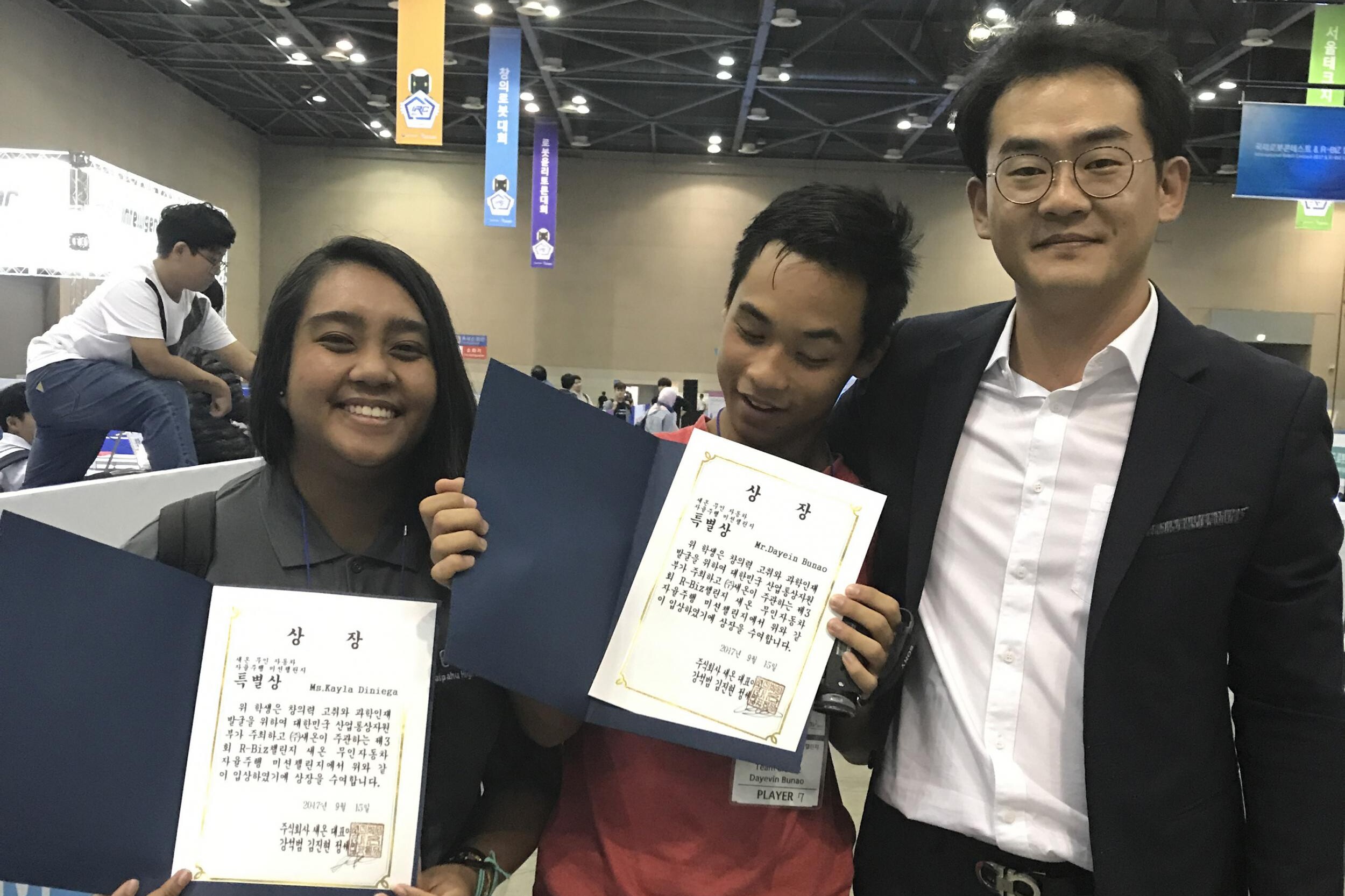
In the final weeks of 2018, Altino gained traction in events such as the Windward PBA Science Fair, Onizuka Day of Exploration, STEMFest, and more. In February of 2019, the founder of Altino and a group of award winning Korean Altino students visited Oahu to teach Altino to their Hawaiian peers and explore the international opportunities that coding and computer science provide.
As we progress towards the summer cohorts planned for 2019, more Oceanit Ohana are being trained as teachers and ambassadors of Altino coding education. Altino is also being spread at events focused on computer science at the state legislature and for Hawai’i public school administrators.
It’s a whirlwind of programming and there’s no sign of stopping- including our popular public events with limited seating. Attend the next dive into innovation in education, and see what Altino can do for everyone, both old and young!
Our next scheduled Altino events are for teacher accreditation; click for details on the 3 day Honolulu Altino event and Kapolei event specifically for teacher accrediation and professional development.
Click here for calendar information including upcoming public Altino trainings.