Redesigning Education for an Online World | Design Thinking Showcase
Please join us on April 24th at 9am HST for the Digital Transformation: E-Learning Models Showcase!
The Hawaii Department of Education and Oceanit have been doing a design sprint with 7 design teams made up of teachers, parents, community members, and students to rethink education for an online world. The design teams have been hard at work collaborating and using Design Thinking to develop potential school/complex area models or components for distance/blended learning.
At this showcase, teams will be presenting their ideas and models and soliciting feedback. Everyone's participation in providing feedback is important as teams move into the final phase of the Design Thinking process! After the designs are finalized, these new models will be shared with HIDOE Complex Area Superintendents, Complex Area staff, and School Principals. Schools and complex areas may consider these models for future distance/blended learning implementation, as appropriate.
Our teams are excited to share their design prototypes with you, and we look forward to seeing you on April 24th! Please come support, and give your feedback on their prototypes. Please RSVP at the link below and feel free to share this invite as well.
Date: Saturday, April 24, 2021, 9:00 a.m. - 10:130 a.m.
(please use the RSVP link below in gray before joining the meeting)
Meeting Number: 120 505 3012
Password: online
Time to Flip the Internship Upside Down: Education, Imagination, and Industry
Internships are great in theory—students get to learn from industry professionals, gain real world experience in a controlled environment, and walk away inspired to focus their education and change the world. But in reality, things aren’t quite so rosy. Often, professionals are too busy for their interns, leaving students with little to do and little to gain aside from a line on their resume. In fact, bad internships are so ubiquitous that it’s common to hear jokes about interns doing nothing but fetching coffee for the office. Other intern programs are structured like classes, where interns are doing mostly theoretical work, perhaps learning about a wide range of industry tools, skimming the surface without interacting with real problems or clients. These programs give students information and know-how but fail to engage students with the realities of the industry.
That’s not to say that professionals don’t care or don’t want to commit time to their interns. In most cases, the opposite is true. Industry professionals see the value in real-world experience for students and recognize that good internships can build a pipeline of potential employees. They want to help students just as much as students want to learn. The real problem is that the goals of industry and education often don’t align, making it difficult for students to learn and professionals to mentor.
From an education standpoint, the more exposure to real world jobs and experiences, the more prepared a student will be. A well-structured internship with an engaged mentor can affirm (or disaffirm) career aspirations, foster soft skills, and demonstrate how knowledge learned at school can apply in the real world.
From an industry standpoint, however, valuable internships require professionals to dedicate a significant amount of time to working with students, taking away time from project and client work. Every hour spent with a student is a work hour that will need to be made up elsewhere, making internships impractical for many companies, especially smaller ones with less manpower. And so, when a company is approached to work with students, unless they are able to dedicate resources towards developing an in-depth internship program, the result is often lackluster—a one-off mentorship session, a tour of the company’s facilities, or even just a monetary donation towards new equipment.
As much as a professional may want to help, traditional frameworks don’t leave much room to do so.
Last year, during a groundbreaking partnership opportunity between Oceanit, the Department of Transportation, and Hawaii Technology Academy (HTA), Oceanit’s Ian Kitajima devised a new internship model that has the potential to solve this disconnect and bring the ostensibly opposing needs of industry and education together.
In June 2020, Deputy Director of the Department of Transportation Highways Division (DOT Highways), Ed Sniffen, contacted Oceanit with a proposal to improve traffic patterns along Farrington Highway leveraging artificial intelligence (AI) and student input. With the enthusiastic support of Director of Partnerships & Innovative Learning at HTA, Mary Wenstrom, 17 high school students, an objective, and a small team of Oceanit technologists, Kitajima set to work imagining how to best serve both the DOT and the students. “And from there we just designed it,” Kitajima explained to a group of educators at the end of the internship. “Literally, after every session ended, we were designing the next session and adapting.”
As Kitajima and Wenstrom worked together to create a program that both involved the students and met project milestones, a logic for this new internship model soon revealed itself.
The model they developed is called Kilo, which means ‘observation’ in Hawaiian, and rests on three pillars: real projects, real clients, and innovation.
In this framework, a three-way partnership is formed between a company, a client, and a set of students. At the center is a project—a problem the client has that requires the industry expertise of the company to solve. The company gives the students the tools to address the problem, providing mentorship and guidance as they work on the project together. The students and the client interface directly, and the students come to understand the motivations, limitations, and possibilities associated with the client and the problem. The end product is a deliverable ideated, designed, and presented by the students.
What sets Kilo apart from more traditional internship models is the interaction between the students and the client. Whereas in a normal internship, student-client interaction is limited at best, the Kilo framework requires students to become well acquainted with the client and their industry, providing vital context to the work being done.
On the other side, the client is able to engage with students in a way that might otherwise be impossible without the presence of the company. Working through this three-way collaboration allows students to see how the company’s industry innovations can apply to the client’s work, stoking interest in not just the work that the company does but the potential within the client’s industry as well.
The benefits of Kilo are multi-fold. As the interns are built into the project, professionals are able to simultaneously focus both on their work and their interns, offering mentorship for the full life of the project—for weeks, months, or even years. Students gain valuable industry knowledge, learning and becoming comfortable using real tools and innovations. The client’s project is strengthened by creative, enthusiastic student perspectives. And the workforce of tomorrow becomes empowered to think creatively to draw cross-industry connections that can facilitate the innovations that shape our future.

For this inaugural internship, students were tasked with coming up with ways to improve traffic safety along Farrington Highway using AI. It began with a briefing on the significance of the project where Sniffen challenged the students to think beyond roads and transportation. This project, he emphasized, should be aimed at improving quality of life for the area’s residents and helping the DOT learn to better navigate community building. Sniffen also gave the students an overview of what the DOT does and what kinds of infrastructure they should be thinking about as they proceed.
The next step was to give the students the tools necessary to move forward with the project. Oceanit’s AI and machine learning team, led by Dr. Mark Kimura, worked closely with students to teach them how to use our Aloha AI platform to read and analyze the data they would collect, how to write algorithms, and how to use AI to automatically perform calculations. Students were able to really get to know and use cutting edge industry technology—not just watch demonstrations.
And then, the students blew everyone’s expectations away. They were more engaged, more enthusiastic, and more creative than anyone expected. Wenstrom recounts, “The students wanted to get really in-depth. Ian had said before, ‘I don’t know if we’re getting too in-depth with them—maybe this should be a bit more surface level.’ But overwhelmingly, all the kids were like, ‘I want to try it myself now. I want to get up and do it.’ And all of our assumptions fell away.”
The key was context. At every step of the internship, Kitajima and Wenstrom made sure to highlight the relevance of the things they were learning—not just for the project, but for the students themselves. For example, early on, Kitajima pointed out that the more tools you have in your toolkit, the more of an asset you are for your company or team. “Having kids hear that—all of a sudden there’s purpose. It’s not like, ‘Oh, why do I have to learn another software?’ Instead, it becomes, ‘Oh, I get to learn another software!’”
Students also came to understand how their school education fits into the real world. As they were faced with a real project, suddenly all the seemingly disjointed memorization that schoolwork entails came together. While it’s easy to see how math and science classes are useful for technology-related projects, Kitajima emphasizes that “when they’re giving a presentation in front of the director of DOT, you bet spelling matters too.”
Another important factor was trust. Kitajima and Wenstrom constantly solicited student feedback and shaped the program around what the students wanted to do. “So many companies are hesitant to do internships, especially with high school students,” Wenstrom observes. “In their minds, they may think that the kids aren’t ready. But Ian said, ‘I’m going to facilitate and guide this and see what comes out of it.’ And it was just as good, if not better, than any internship program I have observed or researched in almost 20 years in education. It is rigorous and relevant to what students care about and it helps them build the skills and dispositions they will need to thrive in companies and organizations in the future.”
Students were also encouraged to use the full range of their creativity. Utilizing Design Thinking techniques, students were tasked with coming up with questions that could contribute to improving traffic safety. The focus of Design Thinking is to create real-world, human-centered solutions founded on empathy and creativity, and nothing is off-limits. Students were instructed to come up with as many questions as they could, drawing inspiration from each other’s ideas. Over the course of four sessions, the students came up with more than 100 questions and collectively selected 12 to send to the DOT for review. This step was the backbone of the project, and these questions laid the foundation for how data was collected and analyzed—the internship truly put students at the center.
With these two factors, context and trust, students felt that their contributions were genuinely valuable and gave their best efforts to the project. As Kitajima explained in a wrap-up meeting, “When we work with these students, we don’t know who they are. I have no history with them. I just know what I see and how they interact with us. So when Mary told me at the end of the semester that they were initially worried about a particular student, I was like, really? Because to me, she seems like a superstar — she’s confident, she’s contributing, she’s engaged. I almost felt like the students that the teachers were most concerned about were the superstars in this program. Maybe because it’s not traditional education.”
All of this, however, would not have been possible without the enthusiastic support of Ed Sniffen and the Department of Transportation. Sniffen is a huge champion of student engagement and believes that it’s critical for the future of the DOT—and the state of Hawaii. “Education isn’t within our jurisdiction, but it is within our connection. Through students, we can engage with the community. And in the end, it’s going to be their infrastructure in five to ten years. If we involve them in the process now, hopefully they can point to an improvement and say, ‘Hey, I worked on that.’”
When students are involved in a project, community engagement naturally follows as their families, friends, and greater school community hear about what the students are doing and by extension what the client is doing. For the client, this offers not only the opportunity for good PR, but also has the potential to save a project from future problems. If community members learn about a project early on and have any issues or objections, they can be addressed in the beginning stages, before too much time and money have been spent.
Sniffen also recognized that going through a company like Oceanit to reach students could be the key to building the DOT’s future workforce. Generally, students looking to enter the field of artificial intelligence and innovative technology are not very likely to consider working for entities such as the Department of Transportation. On the other hand, however, the DOT would greatly benefit from young, highly educated workers who are trained in the latest technologies and can bring new points of view to the table.
Through this Kilo internship, students were able to see first-hand how innovation can be applied to areas that seemingly lack innovative movement, expanding their ideas of what is possible for their future. And the client—the DOT—was able to engage with precisely the kind of future workforce it’s looking for in ways that they could not have done alone. Sniffen explains:
“We’ve had in-person interns before, but students were just working on what was in front of us right now. That’s not what DOT needs—we already know how to do that. We don’t want new engineers to get stuck in the same processes. We want them to be forward thinking. With our old internships, we were pushing people towards our current reality, and that’s not where we want young people to go. Our forte isn’t high-tech. But there are people like Oceanit who are comfortable there, and we want to get there ourselves. Bringing on a high-tech partner allows us to give students the experience that we’d like to [show them], as well as our own staff.”
And so, because this project was framed as a Kilo internship, the DOT received two deliverables: the project goals themselves and a seed of thought placed in the minds of the future workforce of Hawaii.


A student presents their final findings from the project. This student analyzed traffic data to determine whether there were any trends or patterns for different vehicle types.
For Oceanit, the Kilo internship model sits at the intersection of a number of our longstanding pursuits and stands as an embodiment of our philosophy towards education and innovation. Oceanit takes great pride in our island home and believes that Hawaii’s diversity of people, culture, and ideas can make it a global hub for groundbreaking innovations and technologies. Many young people, however, don’t think that’s possible here, opting instead to pursue careers on the mainland. We believe that through education, outreach, and providing a good example, we can reverse the state’s critical brain drain problem. Kilo is the latest step in that endeavor.
For almost as long as we’ve been a company, Oceanit has hosted cohorts of summer interns, shuttling them through a structured program of seminars and project work which culminates in the presentation of a project proposal on any topic of personal interest. Our intern program is aimed at college and graduate school students in the fields of engineering and design and encourages students to keep their talents here in the islands by giving them a first-hand look at what is currently being done and what is possible.
Kilo, on the other hand, allows us to make an even greater impact by starting this process much earlier. Given the deeply interconnected nature of the program, the Kilo model is appropriate even for high school students—as demonstrated through this pilot program with the DOT. If we want to convince Hawaii’s talented young people to stay or return to the islands to work, reaching them during high school is key. By the time students are applying to college, many have already made up their minds about finding opportunity on the mainland rather than here at home. By hosting a Kilo internship, companies can show students how they can use their higher education to make a difference in their own community.
Another important distinction is that Kilo internships run for the full length of a project—whether that’s weeks, months, or even years. This offers an unprecedented opportunity for mentorship and industry insight as students and professionals work together on all stages from ideation to wrap-up—not just three months of work on whatever happens to be going on at the time. Of course, our summer internship program will exist for as long as universities have summer vacation, but Kilo opens up another door towards achieving our goal of building innovative industries in Hawaii.
On the technology side, the Kilo model has given us an opportunity to stretch and test our work a relatively new sector for us—artificial intelligence. Oceanit turned its attention towards the potential of AI about five years ago, considering its usage for a wide range of applications in areas as diverse as disaster recovery, medical diagnosis, and retail. Most of this research and development has been in-house, with the occasional outside partner allowing us to use their facilities as experimental sites. This DOT traffic project was one of the first chances for us to apply our AI research to real client work.
As this internship was centered around a group of students with little technical knowledge, it was the ideal backdrop for a technology that we are still easing into. The project wasn’t too complex, nor did it build upon decades of pre-established company expertise. In fact, student input and ideas might contribute to where we decide to go with AI in the future. The Kilo internship framework gave us the opportunity to further advance our AI innovations, building out our capabilities and project portfolio, which has already begun to generate more work for us in this sector.
For AI researcher Mark Kimura, Kilo also answers a personal philosophical conundrum. “I don’t want to work just for money—I want to feel useful to the community and society. But at the same time, I’m too old to ignore life after retirement, and I’m not quite ready to work for a nonprofit and just subsist. Kilo has the potential to be a great solution for this disconnect. I get to work on a real project from a real paying client who wants to involve students. And if we can find more clients like DOT, this model could actually transform local education and the future workforce.”
Whereas traditional internships may teach students about what an industry is currently like, Kilo internships have the potential to show students what an industry can become, giving them valuable insight to the world that will exist as they enter the workforce and inspiring them to create new pathways that do not yet exist.
Kitajima recounts the moment he recognized how impactful the Kilo model could be:
“As we watched the students present their findings using data generated by artificial intelligence, I looked over to Ed Sniffen and thought to myself that we just cracked the code on how to prepare our students for the future. We prepare them by letting them create the careers of the future. I later said to Ed that DOT Highways doesn’t have an ‘AI Application Specialist,’ but today we watched the birth of a new DOT career created by students.”
Kilo is still a work in progress, and Kitajima and Wenstrom are continuing to refine the model with a second internship with the DOT, this time focusing on speeding. Kitajima also has plans to include other schools in projects with the public library system and the Kohala Center.
But Oceanit is not the only company that can employ a model like Kilo. Kitajima challenges other companies to think about the kinds of projects that will work well with students on board. It can be done within any industry; it doesn’t have to be “kid-friendly.” By itself, the DOT isn’t especially exciting for students—it was the professionals involved that made this project so engaging. As long as industry professionals and clients are excited to mentor and trust in the students, the potential is almost limitless.
Looking Back on 2020 at Oceanit
Nobody, including Oceanit, expected 2020 to be the chaotic and surreal a year that it was. In our 35 years in business, the Oceanit family has not experienced a local and global situation like this. From the global pandemic to incomplete or absent leadership and government policies, there were many reasons to be pessimistic. Hawaii’s tourism industry was hit, highlighting a weakness in economic reliance on one industry, and hundreds of thousands lost their lives across our country.
Despite the chaotic year, we feel a sense of optimism and hope that we can all work through these trying times and bring the community closer together. Oceanit’s focus in 2020 was adaptation... to the new normal, to the evolving pandemic, and to the difficult problems that continue to face the world. Our goal for 2021 is to find opportunity in chaos and roar back, stronger than ever, with and for our home.
In January, Oceanit was featured as an Air Force Small Business Innovation Research (SBIR) program success story. Many Oceanit projects get their start in the Department of Defense’s SBIR programs, which are designed to fund technology development deemed too risky by the traditional business models of large corporations. Our success story featured Oceanit’s High Accuracy Network Determination System (HANDS), a network of observation points around the world that map and track ever increasing levels of space debris, that was ideated, developed, and deployed from right here in Hawaii. https://oceanit.wpengine.com/news/in-the-news-hands-space-debris-and-scientific-success/
In March, the global wave of COVID-19 truly hit the US, and Oceanit, like many others, was forced to shift away from in-person activities to remote working environments. Unfortunately, it meant cancelling our office tours, cancelling events and conferences, and prompted us to seek new ways of engaging friends, communities, and partners.
Oceanit’s S&T team, who were working with the U.S. Defense Advanced Research Projects Agency (DARPA) pivoted work on an AI for cancer genomics https://oceanit.wpengine.com/services/noetic-mathematical-engine/ to focus on SARS-CoV-2 and discovering a way to detect the virus in infectious people using AI. We began developing our ASSURE-19 test kit (embed open-in new tab link) with it, wrote the ALOHA protocol, developed and put into action using our tests to allow for innovation and groundbreaking activity to continue, while keeping the entire Oceanit Ohana and our own families as safe as possible.
In April, Design Thinking strategist Raviraj Pare was named as one of Pacific Business News’ 40 Under 40 class of 2020, continuing a tradition of younger innovators making Oceanit incredibly proud and hopeful for the future of Hawai’i. Past honorees have included Oceanit’s Sumil Thapa and Dr. Michael Foley, among others
At the height of the summer, Physicist Sergey Negrashov partnered with his friends and colleagues at the University of Hawaii to create https://alohamask.org/, a group that went to work producing thousands of reusable cloth mask kits. Sergey worked full time at Oceanit while also recruiting dozens of Aloha Mask volunteers to help cut, sew, and distribute PPE in a time of dire shortages and extreme need. https://oceanit.wpengine.com/news/oceanits-sergey-negrashov-rallies-the-community-around-alohamask/
At her alma mater, Iolani School, Oceanit engineer Taylor Chock joined her sister and other volunteers to lead efforts to fabricate thousands of face shields for healthcare workers across the state of Hawaii. Using Iolani’s lab facilities, Taylor and her team 3D-printed thousands of face shields, a vital part of personal protective equipment, in the school's Sullivan Center for Innovation and Leadership.
In June, Oceanit and our ASSURE-19 rapid saliva tests were selected by the National Institutes of Health (NIH) to participate in a Shark-Tank-esque program called RADx to support quick development of rapid, accessible, affordable COVID-19 tests. Oceanit is now under contract with NIH and the RADx team and advancing our science and production capabilities in pursuit of an FDA emergency use authorization for ASSURE-19.
In the midst of our pandemic response, Patrick Sullivan released the physical edition of his long-awaited book “Intellectual Anarchy: The Art of Disruptive Innovation”. Finally, after years of interviews and conversations discussing aspects of the thought process behind Oceanit’s 35 years of success, the method is captured on paper to help other innovators and businesspeople find success in chaos. (embed site link open in new tab) Dr. Sullivan spent almost five years compiling stories from within Oceanit to put together his book, stories that capture the ‘innovate from anywhere’ spirit that we all value.
Throughout the tumulus year, Oceanit participated in many virtual events that would have otherwise been hosted in person. These included presenting, sponsoring, and hosting at such events as the Hawaii Book and Music Festival, virtual Astronaut Lacy Veach Day, the annual Girl Scouts STEM Fest with a successful virtual experiment, and more. The Oceanit team produced videos for the events or appeared live on-screen to speak with children and STEM educators from all around the state.
The entire team at Oceanit is grateful to have the Hawaii community as our home for over 35 years. The success that we have is due in no small part to the support and partnership with the island’s community, educators, university, and workers and we are very grateful for that kokua. The Oceanit Ohana wishes you and yours a refreshed 2021, full of good health and opportunity.
Virtual Coding Training with Altino on Altinocoding.com
Oceanit believes that an innovative mindset starts with two things: education and imagination. Our SURF (Social Utilization of Resources for the Future) initiative began over ten years ago when we first adopted Design Thinking and began hosting DT workshops and trainings across Hawai’i to spread this method of problem solving. SURF grew over the years to encompass two more programs, Altino: Coding for Non-Coders and the Aloha AI network.
In 2020, our SURF initiative launched a free, online computer science resource for teachers, students, and parents: AltinoCoding.com. With education moving online and potentially being remote for the foreseeable future, the SURF initiative led by our very own Ian Kitajima, launched the new Altino Coding site on September 4th, to provide a virtual training center for our Altino Coding for Non-Coders curriculum.
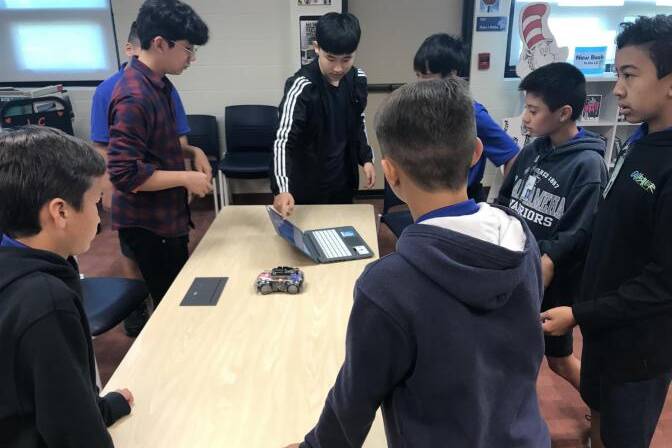
This new online resource features a virtual version of the Altino Car that can be programmed to run code and “drive” on-screen. The SURF team created and recorded the first 20 virtual coding lessons for anyone who is interested to learn creative problem solving skills via coding at no cost, thanks to our sponsors. This new site is based on three years of Oceanit’s in-person Altino Training program, which to date has brought computer science professional development to around 600 K-12 teachers, at 131 public schools.
While in-person classes using the programmable Altino car were popular and engaging – learning while playing – we needed to find a way to ‘go remote’ during the challenges of the ongoing Covid-19 pandemic. So we built the new Altino Virtual Car! The top-down car drives like a video game: users write the command code and then have the virtual car drive those commands, all in a browser page.
To use Altino Online you will need a device like a smart phone, a tablet like an iPad, or a desktop computer; a web browser, and an Internet connection. The website and virtual car are friendly to most smart devices, making the platform accessible to even more learners than the original goal for the in person program. With the pandemic keeping many people at home, adults are now tasked with helping keiki learn virtually. Oceanit’s SURF Foundation developed the self-paced Altino programming video lessons and the hands-on virtual car to be entertaining and engaging for everyone; the programming classes are available to all parents, teachers, and students (either keiki, or just lifelong learners) free of charge to help keep education sustainable during the pandemic and beyond.
———————
A big mahalo to our sponsors for also seeing the vision- the Altino Virtual Car and classes are free of charge to all learners thanks to them, and without them, this would not be possible:
- Kamehameha Schools
- Public Schools of Hawaii Foundation
- Harold KL Castle Foundation
- Hawaii Dept of Education
- Dept of Labor and Industrial Relations (DLIR)
- Omidyar Foundation via HCF
- Servco Toyota Hawaii
- Hawaii State Legislature
Oceanit's Sergey Negrashov Rallies the Community around Alohamask
As a result of the COVID-19 pandemic, hospitals and care facilities around the nation have experienced shortages in personal protective equipment like masks and gloves, and Hawaii is no exception. To help address this critical need, members of the Oceanit Ohana volunteered their expertise to design, fabricate, and rally the community around supporting medical workers.
Among the first to spring into action was Oceanit Physicist Sergey Negrashov, who assembled a small team of UH grad students to produce mask sewing kits and enlist volunteers who can sew the masks and deliver them to the healthcare professionals who need them. The initiative, called alohamask, used UH’s FabLab to quickly laser cut fabric, produce kits, and donate finished masks to frontline workers and vulnerable populations.
Sergey came up with the idea for alohamask after volunteering to sew masks and becoming frustrated when half his time was spent cutting fabric swatches. He soon realized that it would be far more efficient to produce fabric cut-outs on an industrial scale and began to prototype using lasers to do so. When that proved successful, he approached UH to use their 40” x 40” laser cutting bed, which allowed alohamask to cut fabric for 90 masks in a single run.


Given the production capabilities, alohamask quickly scaled up and they became a hub to organize a multi-faceted effort. Their team included volunteer coordinators, hospital liaisons, manufacturing overseers, master seamstresses, and a health & safety officer. Together, they managed a volunteer assemblage of 40 drivers and 400 sewers, fabric donations from groups like Hawaii Community College and First Hawaiian Bank, and deliveries to hospitals around the island. At their peak, the alohamask team was producing and delivering 1000 masks per week.
Last week, alohamask wound down operations after 10 straight weeks of mask kit production and 10,000 masks made and distributed.
Those 10,000 masks went to Shriner’s Hospital, Kapiolani Medical Center for Women & Children, Kokua Kalihi Valley Community Health Center, Honolulu Fire Department, Kupuna Kokua, and Wahiawa General. Alohamask were also able to cut fabric for other volunteer sewing groups such as UH CTAHR sewers, UH Theater, Riveters for healthcare workers, and UCERA as well.
The decision to wind down was made now that traditional supply chains have finally caught up to needs for many facilities around Hawaii. While alohamask is no longer in operation, Sergey notes that they’re ready to spring back into action should the need arise.


Self Improvement in Social Quaratine
The COVID-19 pandemic is disrupting the lives of people all around the world. For Hawai’i, this viral outbreak is exposing shortcomings in our reliance on tourism as the main driver of economic wellbeing. While events like the 9/11 attacks and Great Recession have shaken economies before, COVID-19 will almost certainly have unprecedented and unique impacts.
Oceanit has called Hawai’i home for 35 years, and has weathered ups and downs before. We firmly believes in economic diversification and growth by evolving our education mindset, training in future-proof skills, and embracing lifelong learning. We must take risks, experiment, adapt, and change to keep up with our world.
We believe education and enrichment of the mind should not be viewed as an activity that ceases after 13 or more years in traditional school environments, but as something that we do throughout our lives. The people of Hawaii have always adapted and innovated to make life on our precious islands possible and we are glad to have the ability to share some of the services below that our Ohana use to keep learning.
Resources that have become available due to COVID-19 include the following:
https://open.umn.edu/opentextbooks
https://;jstor.org/open
and others: Many colleges and universities, including Cambridge, are opening up their digital textbook archives for everyone to use. However, at the time of this writing, several have been taken temporarily offline due to misuse and server issues- please search for “free textbook online” to see what is currently available- but NEVER enter in personal information or download a file (use a web reader exclusively), only read from reputable sites (.edu is generally a good sign) and take other precautions with your digital footprint.
https://artsandculture.withgoogle.com/en-us/ While this is not your standard educational resource, visiting National Parks is an eye opening experience that people have done for generations. While that’s physically impossible at the moment, now people around the world can experience some of America’s finest natural environments.
https://www.varsitytutors.com/ Has created the “virtual school day” for K-12, free for all since schools have been closed down for the foreseeable future. Includes live lessons, flashcards, quizzes, and more for a classroom experience.
https://www.futurelearn.com/courses/covid19-novel-coronavirus One of the best ways to control fear is to learn more about a situation. This free course is for “Those working in or around health, or anyone interested in how we should respond to the outbreak”, but no pre-existing knowledge is required to take and benefit from this course.
https://www.classcentral.com ClassCentral is a resource generally used to compare college course content, teachers, and more in order for students to make informed choices on what they take- but they have responded to COVID-19 by featuring a large selection of online classes offered by Ivy League schools for free.
In addition, there are various resources the Oceanit Ohana are fond of that have been available before the shelter in place orders went into effect:
Learn:
www.coursera.com online learning from accredited colleges, free/audit or pay for cert/credit
www.khanacademy.org/ more student and math based
http://www.duolingo.com language learning, app and web based
http://www.Benelab.org search engine with proceeds to charity
https://en.wikipedia.org/wiki/Special:Random a random wikipedia article to learn about something new
Mental Breaks:
www.animalplanet.com/tv-shows/too-cute/ looking at cute things is scientifically proven to release endorphins in your brain
https://www.tinypulse.com/blog/sk-desk-exercises simple ways to move at your desk
Focus and Productivity:
https://tomato-timer.com/ pomodoro timer for task management and working from home focusing
https://getcoldturkey.com/ extension that blocks time-sucking websites for predetermined amounts of time
Two highly rated and popular youtube videos of non-vocal, calm music that can help some people focus at work and block out distractions
If you are facing financial hardship due to the effects of COVID-19 on the economy, please see here for resources that may help: https://abcnews.go.com/Business/financial-assistance-coronavirus-crisis/story?id=69689211
Please remember that your mental health is also important during this time:
PDE3 Learn 2 Code: Altino for Hawaii's Educational Professionals
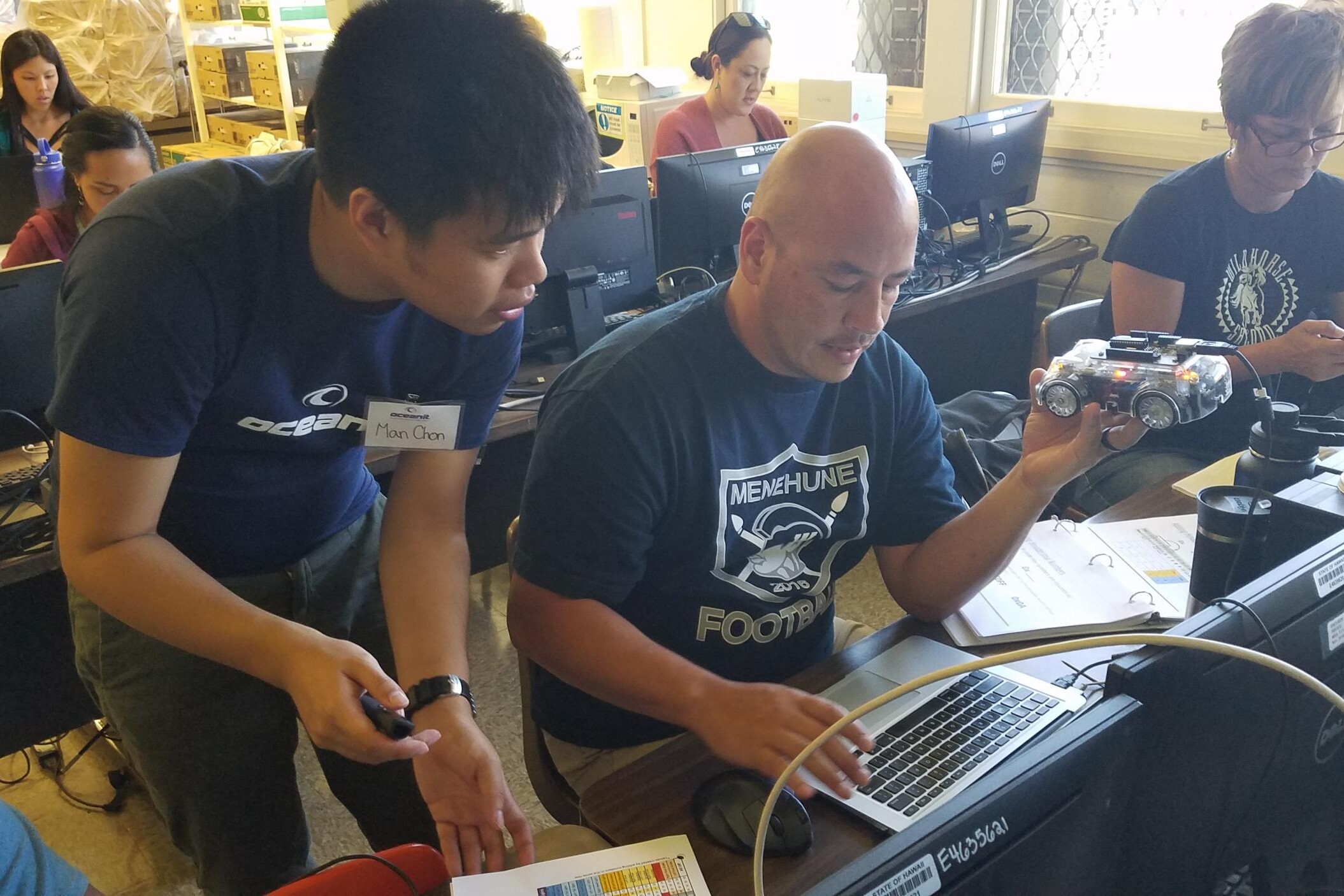
Since 2017, Oceanit has trained 555 teachers from almost 250 schools using the Altino coding system, creating a STEM education snowball effect to reach as many of Hawaii’s students as possible and setup a future of computer science understanding.
We continue this trend into 2020 by inviting more K-12 educational professionals to join us for a 3-day, DOE-accredited Altino course, generously funded by the Public Schools of Hawaii Foundation, Kamehameha Schools, and Toyota Hawaii.
Oceanit’s complex-based curriculum development is the hallmark of our training system; bringing together teachers from grades K-12 who are working in the same complex. This approach creates the opportunity for educators to develop a cohesive, comprehensive curriculum that can grow with students as they progress through grades and schools. The following complex dates and locations are scheduled Altino courses for 2020.
Setup for each class begins at 8:00 a.m. and the day ends at 3:30 p.m. No previous coding experience is needed to take advantage of the intro courses, but some experience may be necessary for ‘Advance’ courses. If none of the below dates and locations work for your educational group, SCHEDULE YOUR OWN – Find 3 days that work for your teachers and contact us via email here.
REGISTER: https://pde3.k12.hi.us
- March 16-18 Campbell Kapolei Complex Intro Coding PDE3
- March 19-21 Maui Complex Intro Coding PDE3
- June 3-5 Campbell Kapolei Complex Advance Coding PDE3 – online
- June 8-10 Statewide Scratch PDE3
- June 10-12 Maui Complex Advance Coding PDE3
- June 17-19 OPEN
- June 24-26 AMR Complex Intro 3 day/3 credit PDE3
- July 1-3 Leilehua Complex Intro 3 day/3 credit PDE3
- July 8-10 AMR Complex Advance 3 day/No Credit
- July 15-17 KMR Visual Block Coding (Scratch) PDE3
- July 22-24 (NEW DATE) Altino Statewide Advance PDE3
- Oct 12-14 Kauai Complex Intro 3 day/3 credit PDE3
- Oct 14-26 OPEN
Training Teachers with Altino Introduces Students to Creative Problem Solving & Uplifts Hawai’i
Present Frustrations
According to a 2016 study conducted by Aloha United Way, 48% of working families in Hawaii can’t afford to live to live in the islands. This is largely due to the high costs of living and low wages—Hawaii is consistently ranked as the most expensive state to live in, while 62% of jobs in Hawaii pay less than $20 per hour. A recent HUB report listed $93,000 for a family of four as low income in Hawaii.
As we come into the 21st century, however, Hawaii has the opportunity to write its trajectory. Between 2014-2024, computer science-related jobs are expected to grow by almost 11% in Hawaii—6% faster than the forecast for general job growth. And as of 2016, these types of jobs had a median hourly wage of almost $36—just about double the median wage for all jobs.
Whether our children are able to capitalize on this growth, however, will depend largely on their pursuit of higher education—particularly in computer and STEAM-related fields. As of 2017, there were roughly 1,400 unfilled computing positions but just 134 computer science graduates from the University of Hawaii.
Beyond computer science, in order to thrive in the coming decades, Hawaii needs to create other industries and companies that create higher-value products and services, and in turn, higher wages. This innovation-based economy will require us to teach our keiki to be creative problem solvers, able to spot opportunities others cannot yet see, overcome never-ending obstacles, and connect it all together across multiple disciplines to create game-changing solutions. We believe that this process starts in our classrooms. By exposing every student to coding in the classroom, we can create a pathway to developing creative critical thinkers with the potential to create their own innovative companies and careers and transform Hawaii’s economy.
Oceanit’s Solution: Altino
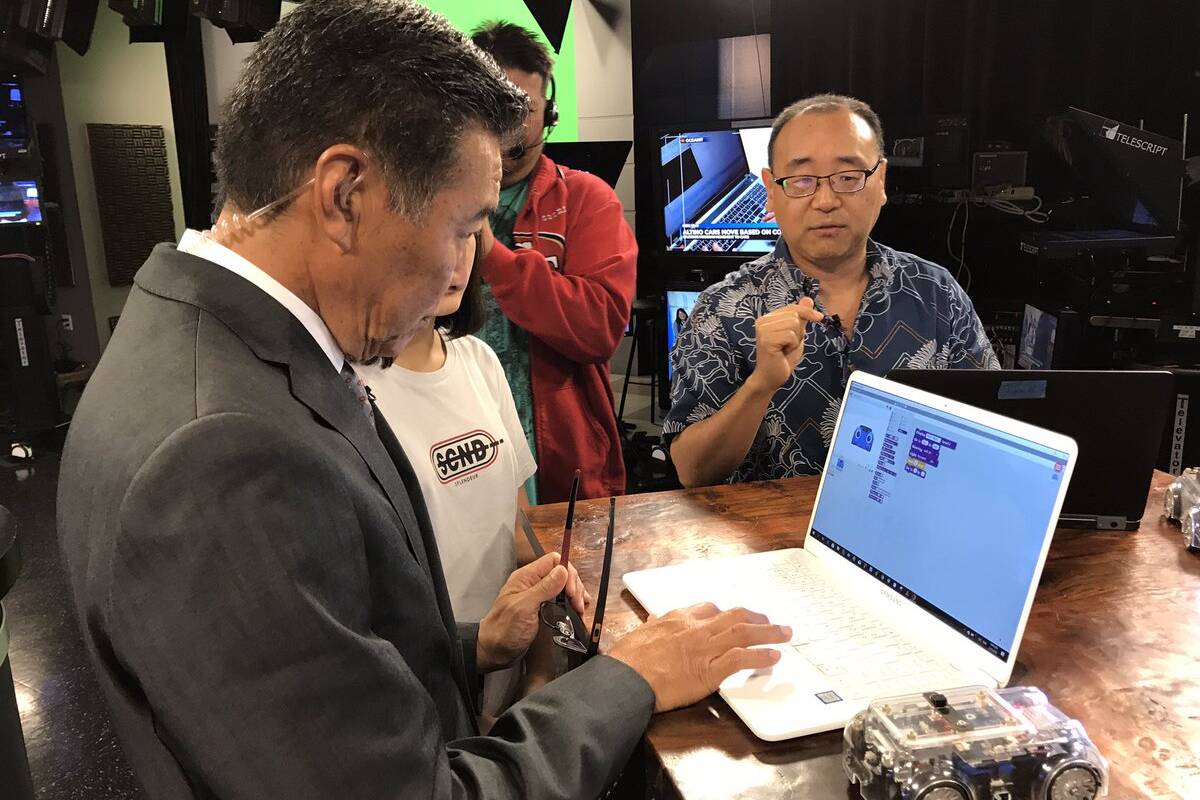
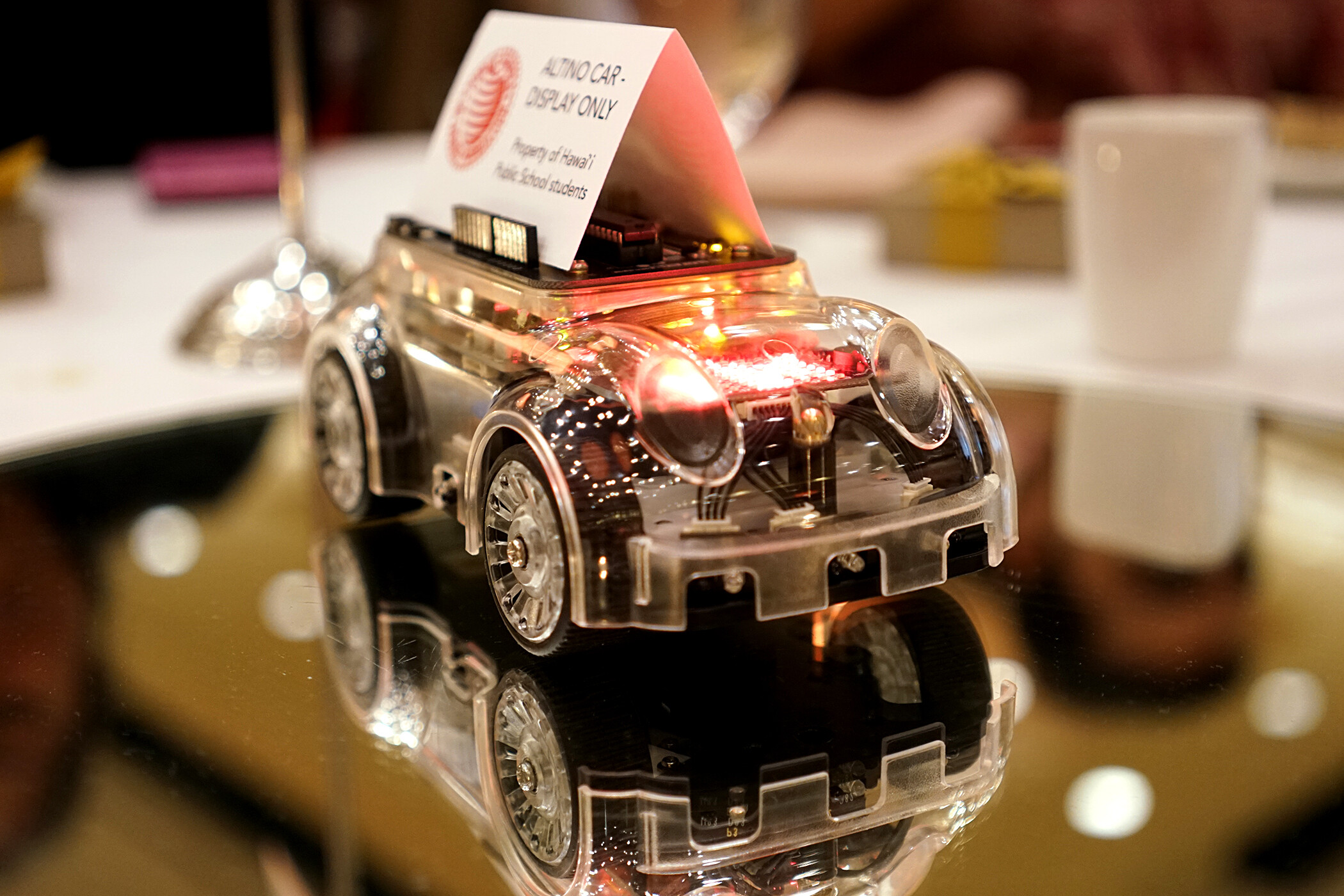
Altino is a small, programmable car developed by SaeOn, one of Oceanit’s partners in South Korea. Using Altino, Oceanit aims to train 5000 primary and secondary school teachers—across all subject areas from English to PE—how to code over the next 5 years. Teachers can then, in turn, instruct students to use Altino or incorporate other coding-derived principles into their curricula.
The Altino coding car allows non-technical teachers to learn the basics of coding in as little as two days. It can do a wide variety of different actions, including a fully autonomous mode using its six infrared sensors, and because there are no parts or pieces to reconfigure (in contrast with robots), 100% of the time is spent on problem solving and coding. The car has multiple sensors and capabilities to keep students engaged from K-12. When students go from elementary to middle and high school, they stay on the same Altino platform—no upgrades or additional equipment required. And as a result, the focus is on tougher coding challenges, learning new programming languages like Python, and doing thousands of Arduino open-source hardware projects.
Oceanit’s Altino training program is one of the only a few computer science training programs to be Department of Education-approved for three professional development credits for teachers. To earn this accreditation, training must meet the same academic demands as a university course.
Training Teachers Is Key to Consistent Exposure
Why train teachers—non-technical ones in particular? We designed our Altino training system to bring systemic change to education through a two-fold approach: first by teaching coding to more teachers, ensuring that students receive coding instruction in the classroom rather than as an elective or extra-curricular activity; and second, by helping teachers redesign existing subject areas like language arts and history to teach creative problem solving skills and increase the likelihood that students at any school can receive coding instruction during at least one class period every day. This addresses several of the largest hurdles that computer science education in Hawaii currently faces, namely a lack of computer science (CS) teachers and inaccessibility to most students.
Studies show that repeated exposure is key to getting students not just interested in but actually studying computer science in post-secondary education. And while exposure is the most critical element, experts argue that timing is also important—a younger student who still has more flexible thought processes will find it easier to think of coding as a tool rather than an obstacle and will normalize the process of breaking down larger problems into manageable, solvable pieces.
Our goal is to expose 100% of students in K-12 to coding, and the only way to scale up and achieve this cost-effectively is to train teachers. Given that elementary teachers reach about 25 students per year and middle and high school teachers reach around 100, on average, a single teacher reaches about 50 students per year. By training 5000 teachers, we have the potential to reach 250,000 students—when Hawaii’s K-12 population is a little more than 180,000.
Immediate Impacts
In 2018, Governor Ige signed two bills into law in support of computer science education. Acts 51 and 168 require Hawaii’s Department of Education to develop and implement a statewide computer science curricula plan for public school students in K-12 and ensure that each public high school offers at least one computer science course each school year by the 2021-2022 school year.
While schools and teachers are enthusiastic about being able to offer more students the opportunity to learn this increasingly vital skill, because of the short timeline, there is also the concern of whether it can be done effectively from the start. Our Altino teacher training program is a direct answer to this challenge. It is accredited, proven, and trains current teachers—meaning schools don’t have to hire staff for just one or two classes or compromise funding for other programs.
Successes to Date
- Increasing Reach Every Year: Since 2017, Oceanit has conducted several successful workshops for teachers on every island, training a total of 555 educators from 249 schools, who have the potential to reach up to 27,750 students.
- Complex-Based Curriculum Development: One of the hallmarks of our training system is that it brings together teachers from grades K-12, who are working in the same complex. This creates the opportunity for educators to develop a cohesive, comprehensive curriculum that can grow with students as they progress through school. One-third of our training program is dedicated to curriculum development, and teachers who have gone through our program have designed innovative curricula that blend coding with subject areas like history, music, automotive, construction, and health.
- Education-Focused Partnerships Extend Our Reach: Our partners include Kamehameha Schools, the Public Schools of Hawaii Foundation, the Department of Education, the Department of Labor & Industrial Relations, the Harold K.L. Castle Foundation, Toyota Hawaii, and the Hawaii Community Foundation (Omidyar Fund).
- Taking Altino Beyond Schools: Aside from working with teachers, Altino has also been used in a program we call “Code 4 a Future,” implemented at Halawa Correctional Facility. The inaugural class in May 2017 consisted of a mix of prison education staff and inmates that met every Friday afternoon over the course of 12 weeks. As of October 2018, 80 inmates have gone through either a basic or intermediate coding course with an additional 100 expected to receive training by the end of 2019.
Visions for the Future
Looking forward, Oceanit believes that the Altino training program can alter the future of Hawaii by creating generations of creative problem solvers. Over the next five years, we hope to be able to expose every student in Hawaii to creative problem-solving via computer programming, becoming the first state in the country to have statewide exposure. This, in turn, may open new career pathways for our children and our state. While computer programming is still largely considered a white-collar profession, there is a growing demand for blue-collar coders capable of maintaining code for a corporate website or government system, for example. This opens lucrative pathways for those who might not want or be able to pursue a four-year degree, further broadening the job prospects for our soon to be coding-capable youth.
The Truth About Altino
It’s not all about training coders. Altino is about inspiring the next generation of innovators, problem solvers, and technologists, and about creating a technology workforce in Hawai’i.
Research and developments in science often die in a laboratory without practical applications, but once a scientific breakthrough can be applied to solve a real-world problem, that’s where the magic happens. It’s gratifying to see the our work impacting so many different industries, but our most meaningful development work has been done with Hawaii’s educational community. At Oceanit, we are privileged to work closely with the students, teachers, and groups from across our community, and Altino cars have been a big part of our involvement in the past several years.
Our hope is to reach 5000 teachers by 2022 and work with them on computer science skills that can be built into our state’s classrooms and lesson plans. The ripple effect will be to reach all of our students with not only CS skills, but problem solving and critical thinking skills. Altino builds those skills through a haptic prop: a car. Everyone knows how a car should drive, steer, and accelerate, and beucase of this ubiquitous understanding, we have an opportunity to show how coding can be used as a language of problem solving.
Oceanit has reached hundreds of teachers over the past couple years as we have taken Altino on the road to complexes around the state. This also means we receive truly meaningful feedback, proving we are helping make a significant impact. This real, honest feedback from one of our trusted educational partners is one such commentary.
My thoughts about using Altino Cars
Sept 2019
By D.S., Librarian, Salt Lake Elementary
Giving students the opportunity to work with the Altino Cars goes way beyond just coding and programming. I have seen firsthand how all the other kinds of learning becomes a part of their process. First of all, it’s important to state that the capabilities of these cars enables a range of learners to be exposed to the world of coding and programming – from the beginning programmer to high school and maybe even beyond. The real life applications are only limited by the mind of the person designing/structuring the learning.
Students have to use math skills to convert parameters and when we asked students how they came to their answers, we found they came to their answers in different ways – promoting flexibility in how they manipulate numbers.
Most importantly, programming with these cars have really forced our students to develop a growth mindset simply because the cars are so highly engaging. All too often in education, we don’t want to see our students struggle and become frustrated so we don’t allow them to experience that feeling and learn what it’s like to push through and feel accomplished. Yet, we expect them to learn perseverance, persistence and develop grit. Those things cannot be developed if learning opportunities are not designed to let them struggle a little. It’s a beautiful thing to watch kids become frustrated or challenged but persevere because they know that is the only way they can get to what they desire, which is to test it out with the car. And it becomes even more impactful when they realize they can do it. It just may take numerous tries. It teaches them there really is no such thing as failure. “Failure” is just getting them that much closer to being successful. Our kids have had to learn to work with others, compromise their thinking sometimes, communicate with others and very importantly to be deliberate and precise. They have to solve a problem which is what I feel is at the core of coding and programming in real life. I’ve talked to them about where we see coding and programming in real life but they just see the end results. This is teaching them what’s behind it and what had to be done to “get there.” Someone had to code/program it. Someone had to observe or communicate with others to develop it. Someone had to discover there was a problem or think that something could be done better or more efficiently. Allowing students the opportunity to work with these cars have really opened their eyes to the world of programming but more importantly have taught them other things that will carry over into everything they do in the real world in order to be successful at life. I live to witness these moments. It is why I became an educator.
If you want to learn more about the Altino program or about summer Altino Training cohorts for teachers, which earn PDE3 credits, please click here.

IN THE NEWS | Patrick Sullivan on PBS Hawai'i
Oceanit is proud to have PBS Hawai’i feature Patrick Sullivan’s fascinating origin story on their Long Story Short program. Oceanit’s Founder and CEO dove deep into his childhood education with Presenter, Leslie Wilcox, to share his personal journey and discuss why and how Oceanit operates the way we do, while staying right here on the ‘aina.
Patrick Sullivan has been a problem solver from an early age; creating enterprising ways during his teenage years to support his pursuit of higher education. He discusses how his hard work and resourceful nature helped pave the way for successes in life, and how he has made a career out of innovative problem solving with his Honolulu-based ‘Mind to Market’ company, Oceanit.
Parts One and Two have both aired on PBS Hawai’i and are now embedded below for those who missed the original broadcast! Enjoy this unique and expansive look into the inner mindset and workings of our “fearless leader”!