


Hawaii Book & Music Festival 2021 | Conversation: A Different Model For Diversifying Hawai‘i’s Economy
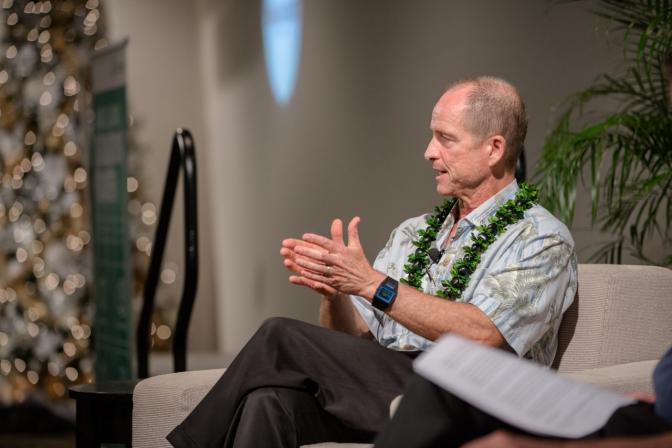
 On Thursday, October 14 from 4:00 - 5:00pm, Dr. Patrick Sullivan will join host Roger Jelenik for a discussion titled, "A Different Model For Diversifying Hawai‘i’s Economy."
Patrick K. Sullivan is the Founder, Chair and CEO of Oceanit Laboratories. He holds a Ph.D. in Ocean Engineering from the University of Hawaii, Manoa and a BS in Engineering from the University of Colorado, Boulder. He is the author of Intellectual Anarchy: The Art of Disruptive Innovation.
Roger Jellinek has been Executive Director of HBMF since 2006. He’s been involved in book publishing for over 50 years in New York and Hawai‘i — as a New York Times Book Review editor, as a trade book editor, science newsletter publisher, literary agent, and map publisher. He and his wife, actor-director Eden Lee Murray, arrived in 1992, and live in Kahalu’u, ‘Oahu.
RSVP at the link below.
The 16th annual Hawaii Book & Music Festival returns virtually, October 1 – November 4, with its core program of Hawai‘i Authors, and community thought leaders and experts in Hawai‘i Sustainability & Resilience, Health & Wellness, Innovation Future, Hawaiian Culture, amplified by national and international Authors addressing some of the greatest issues for Hawai’i’s future.


No Limits Featuring Noam Chomsky, the Father of Modern Linguistics
On July 8th, 2021, Oceanit welcomed the venerated Dr. Noam Chomsky as a No Limits Speaker Series guest. For over one hour, Dr. Chomsky spoke to a live webinar audience of nearly 400 as he delved into the deep fundamentals of language in his presentation entitled: “Know Thyself: Language, Creative Intelligence, and the Fate of the Human Experiment.”
During his presentation, Dr. Chomsky spoke extensively on the concept and quandaries of Universal Grammar (UG)—a theory that posits there are innate human factors that underlie every language and make language acquisition possible. Upon first examination, UG seems to be impossible with goals that appear to be contradictory. However, over the course of the hour, Dr. Chomsky demonstrated that a paradigm shift—regarding language not as a system of communication but rather as a system of thought—is all it takes to see the biological basis of human language.
As Dr. Chomsky drew connections between language and thought, he touched on evolutionary biology, history, philosophy, mathematics, and political science, wrapping up with a discussion of the paradox that is the human mind. “Following this path of inquiry,” Dr. Chomsky said, “we might hope to get real insight into the nature of language and thought, fundamental features of the human capacity. Fundamental, but of course, not all-inclusive. When we look around us, we see other striking features of this strange creature that recently appeared on Earth.” Features such as the self-destructive tendencies that have led us to the brink of nuclear war, climate emergency, and gross inequality.
Oceanit has been working with Professor Chomsky for around five years, developing a linguistics-based Artificial Intelligence that we affectionately called NoME. NoME stands for Noetic Mathematical Engine, but is pronounced in the same way as its namesake. NoME is an Anthronoetic, or human-style, cognitive engine with a linguistics-centered approach to strong artificial intelligence.
Enjoy the video of Professor Chomsky’s No Limits presentation below and be sure to visit his website to learn more about the father of modern linguistics.

IN THE NEWS | Invest In Interns To Build Hawaii's Future, Civil Beat
When Oceanit’s Patrick Sullivan was invited to submit an essay to Honolulu Civil Beat’s IDEAS section, he wanted to share a positive message during this chaotic year. He decided to talk about Oceanit’s summer intern program and how with we can choose to do more than tourism for the future economy in Hawaii.
IDEAS is a space created by the Civil Beat news organization dedicated to essays, analysis, and opinion pieces that forward the paper’s mission of cultivating an informed body of citizens, all striving to make Hawaii a better place to live.
2020 has been an incredibly difficult year for many people around the world and in our home of Hawai’i. This year has given us many valid reasons to be pessimistic, including Hawaii’s deflated tourist economy, incomplete or absent government policies, outmigration, and of course the global coronavirus pandemic.
Despite all this, Dr. Sullivan shared our optimism for the future that stems from experiences in working with over 700 bright student interns throughout the years. He discussed how he still has optimism for the future version of Hawaii. Instead of the present approach where we spend resources to import goods and “experts”, we will create solutions “from Hawai’i to the world” and will be able to keep our most precious resource: our kids.
Click here to see Dr. Sullivan’s full essay on the Oceanit intern program, our mindset of our students being the key to our future, and how education and imagination should be nurtured and supported, not exported.
Here are some past articles from recent Oceanit summer intern program classes:
- https://oceanit.wpengine.com/our-stories/ai-internship-connects-students-with-dot/
- https://oceanit.wpengine.com/news/intern-outreach-for-hawaii-schoolchildren/
- https://oceanit.wpengine.com/our-stories/education-imagination-summer-2018-interns-at-oceanit/

IN THE NEWS | Oceanit News Update October 20th
Oceanit continues to earn local and national media coverage for our work during the ongoing global pandemic; both in direct response to our ASSURE-19 rapid saliva test development and on our efforts to help Hawai'i rebuild stability and sustainability in education, jobs, economic diversification, and more.
The Oceanit Research Foundation and SURF initiative have received wonderful feedback for the successful launch of https://www.altinocoding.com/. The website was launched with the help of our sponsors to offer our Altino Coding training program virtually and completely free. While schools and remote learning remain in a state of constant change during this unorthodox time, a usable platform for teachers and students makes sure that important computer science skills aren't falling to the wayside. Oceanit joined the CoronaMama Zoom Room show to speak about online learning using Altino, watch the episode here: https://bit.ly/2HvML9z
On October 8th, Hawaii Public Radio spoke about ASSURE-19 and how it could impact safe reopening in Hawaii, just one week before transpacific flights with quarantine exemptions would restart. For Hawaii residents, questions still lingered on how, when, and where inbound visitors would test for Covid-19 to ensure we keep our island safe. ASSURE-19, with its speed, convenience, and low cost, was at the forefront of many minds as a possible solution. You can listen to the show here: https://bit.ly/37pbzey

On October 16th, CEO Dr. Patrick Sullivan had a virtual conversation with Honolulu Star-Advertiser on their Spotlight Hawaii livestream show. He spoke about all-things-ASSURE-19, including time frame, FDA authorizations, costs, and keeping manufacturing in Hawai'i. Check both the video and the article at these links:
- Article synopsis- https://bit.ly/2IJEwYb
- Full video- https://bit.ly/3ji3GtB
Outside of the benefits of rapid regular Covid-19 testing, the economic potential of producing coronavirus tests in Hawai'i is unprecedented, especially with the current economic state. We truly feel that this could be a jumping off point for a new economic mindset in Hawai'i. Training workers, who may have been laid off due to the pandemic, in medical technology is one step in the long-discussed process of making Hawai'i a more self sufficient economy. Hawaii Business News discusses this economic reinvention in this October 19th article: https://bit.ly/2ThFwoE
We are moving quickly to complete ASSURE-19 data collection to meet FDA application standards and obtain emergency usage approval, which we expect to achieve in a matter weeks. FDA authorization is required in order for the ASSURE-19 tests to be used in a non-experimental setting and for results to be accepted by the state for travelers. The Star Advertiser discusses protective equipment and ASSURE-19 in an article, here: https://bit.ly/35jem6s
The University of Hawaii Shidler College of Business Alumni Association and the Travel Industry Management International, Inc hosted Dr. Patrick Sullivan ang with Lt Gov Josh Green and more Hawaii leaders for a webinar on supporting the re-opening of Hawaii’s tourism industry. A panel discussion on Re-opening Focused Health Safety Technology & Policy Innovation was published October 7th, and you can watch the live recording here:
https://www.youtube.com/watch?v=3VeLIGbadtg

IN THE NEWS | The Aloha Protocol for a safer reopening with ASSURE-19
As Oceanit moves ahead with in-vitro and in-vivo testing for the ASSURE-19 rapid point-of-need test kits, Hawaii is seeing high, sustained counts for new covid-19 cases each day.
Oahu reentered lockdown last week with the U.S Surgeon General, Jerome Adams joining local officials to announce the new restrictions that will last for at least two weeks. With many in the islands working in the tourism and hospitality industry, and related businesses, a true reopening of Hawaii is dependent upon being able to ensure the safety and health of both incoming tourists and all of our residents in the islands. Oceanit CEO Patrick Sullivan was interviewed by the Washington Post, Honolulu Star Advertiser, and NPR Hawaii Public Radio to share how things are progressing with our work (links below).
Testing for high-risk, pre-symptomatic and asymptomatic people is crucial. And in order to achieve both that level of speed and test availability, a low-cost solution is required. The Aloha Protocol was designed by Oceanit to make persistent testing mandatory for all those stepping off planes in the Islands. The day of travel, upon arrival, and for 5 days thereafter, passengers would self-test with ASSURE-19 kits, each day reporting their result via a smartphone app. Negative tests allow them to move about freely, but a positive test would indicate that they are about to reach infectious levels and should quarantine and/or seek further PCR testing.
This multi-day regimen would also be made available to those who have known contact or exposure to infected persons. Rather than waiting for symptoms to be deemed authorized for a PCR test, and then waiting days more for results, a person could monitor rapid results over a course of days to see if they need to quarantine immediately.
The ongoing trials for ASSURE-19 are bringing us closer and closer to making the Aloha Protocol a reality. In the media coverage below, Patrick Sullivan shared his thoughts on a safer reopening using the ASSURE-19 rapid point-of-need test kits. Read more at the links below:
8/29 Washington Post: Months into the pandemic, still no easy answers on coronavirus testing
8/29: Star Advertiser new editorial: Editorial: How Will Tourism Return?
8/28: Pacific Business News: Oceanit's Covid-19 test begins trial with the Queen's Medical Center
8/28: Hawaii Public Radio NPR, The Conversation: The Conversation: Hawaii's COVID-19 Research On Testing, Vaccines and Treatment

IN THE NEWS | ASSURE-19 Clinical Testing with The Queen's Medical Center
Oceanit and our partners are continuing to build momentum and garner attention on our COVID-19 testing efforts during this global pandemic. The Honolulu Star Advertiser recently spoke with CEO Patrick Sullivan for the latest updates on Oceanit's ASSURE-19 development. The article was featured on the newspaper's Monday front page. ASSURE stands for ‘Accelerated Sensor Solution for Urgent Response to Epidemics' and is specifically developed for COVID-19. You can read more about the ASSURE-19 test here.
Dr. Sullivan spoke to The Star Advertiser's Mindy Pennybacker about the ASSURE-19 rapid spit test that we believe will help to protect lives and responsibly help to restore the economy. The test is a Lateral Flow Assay (LFA), similar to a common pregnancy test, that uses a custom capture molecule and detector molecule, engineered for purpose by the ASSURE team. The capture and detector molecules are novel and unique, a truly one-of-a-kind approach to COVID-19 respiratory disease detection.
In the Star Advertiser article, Dr. Sullivan discussed being on the verge of clinical testing with The Queen's Medical Center. Dr. Todd B. Seto, the center’s Director of Academic Affairs & Research, also spoke about how his team will initially test 30 people using both a nasal swab PCR test and ASSURE-19. Our teams will compare results and use the data to initiate an expedited approvals process with the U.S. Food and Drug Administration.
In our forthcoming testing, The Queen's Medical Center will be pursuing analytic validity for ASSURE: limit of detection, cross-reactivity, inhibition, and stability, in parallel with clinical validation against RT-PCR.
Also on Monday, August 3rd, Dr. Sullivan was invited to join KITV 4's evening Island News program for a live interview about ASSURE-19's progress. Dr. Sullivan joined hosts Mika Miyashima and Brenton Awa on the 6:30pm segment to share our progress with KITV's audience. See the video, below, for the news segment discussing our test, how it works, scale up, and its potential to reopen Hawaii.

IN THE NEWS | ASSURE-19 Spit Test Development
 Following Oceanit's participation in the National Institutes of Health (NIH) Rapid Acceleration of Diagnostics (RADx) shark tank, Oceanit was featured on Hawaii News Now and Hawaii Public Radio to talk about our ASSURE COVID-19 test development. ASSURE stands for 'Accelerated Sensor Solution for Urgent Response to Epidemics for COVID-19', which you can read more about here.
Visit KGMB Hawaii News Now to view the Oceanit ASSURE-19 segment here: https://www.hawaiinewsnow.com/2020/07/01/spit-test-could-be-covid-game-changer-says-honolulu-company/ and listen to CEO Patrick Sullivan's call-in to Bytemarks on HPR here: https://www.hawaiipublicradio.org/post/bytemarks-caf-keeping-covid-testing
NIH's RADx program is a $1.5 Billion investment program to speed the development of quick, accessible, and novel COVID-19 tests. Oceanit presented to the NIH panel in June and we are now awaiting further notice regarding a decision on funding for our ASSURE project work. Oceanit's "spit test" is a novel COVID-19 testing approach requires no blood samples, nasal swabs, or lab equipment with days-long waiting times. We measure our spit test results not in weeks, days, or even hours, but in minutes with 97% specificity to the COVID-19 virus.
“We proposed a simple Spit-in-A-Cup-Test that is fast, cheap and accurate, which could be used to simply test at home, at school, at work, or airports,” says Dr. Patrick Sullivan, Oceanit’s CEO. “It doesn’t require any equipment and produces a result in about 10 minutes. However, using our Image AI app, the result could arrive even faster, perhaps in just a few minutes. Our goal is to have this working on August 1st, but we will also have to clear the necessary testing and approval hurdles .”
At scale, the consumer cost of Oceanit’s COVID-19 spit test would be a few dollars per test and manufacturing could be ratcheted up quickly. The technology, developed by Oceanit, is a result of many years of research and development in Artificial Intelligence and genomics, and is being done in collaboration with multiple institutions, including the University of Hawaii, who has been an indispensable collaborator.

Work and Play: An Identity of Indiscernibles
by Jeffrey Watumull, Ph.D.
The ironist Christopher Hitchens once described his morning mental workout: “Every day, the New York Times carries a motto in a box on its front page, ‘All the News That’s Fit to Print,’ it says. I myself check every day to make sure that the bright, smug, pompous, idiotic claim is still there. Then I check to make sure that it still irritates me. If it does, then I know I still have a pulse”. Hitchens concluded by “credit(ing) this daily infusion of annoyance with extending my lifespan”.
Indeed every day I too am revivified by injections of comparably pompous claims, regularly those that are importantly if implicitly philosophical, but which assume or imply fallacious or false ontologies and epistemologies. The nature of knowledge—and the intelligence whereby it is created—is primus inter pares—the first amongst many equal—of philosophical problems and, given my nature and profession as philosopher and linguist, claims about it thoroughly annoy me.
Nevertheless, because of these annoyances, I know, as Hitchens did, I still have a pulse and hence I do relish the chance to debate and dispel such claims; and I know in my bones these rejoinders are life-extending!
The epistemological claim that quickened my pulse this evening is one conjectured in the surpassingly splendid Intellectual Anarchy: The Art of Disruptive Innovation by Dr. Patrick K. Sullivan. The offending chapter: “Emotion Drives Innovation”.
In this chapter, Dr. Sullivan argues that “positive emotions rising from a sense of fun and playfulness can lead to increased engagement, productivity, and creative thinking”, exhibiting “the connection between cognitive and emotional abilities”—a connection exemplified by legendary physicist Richard Feynman, who, at a dark time in his life, having been “too burned out for serious work, […] decided to just enjoy himself, with no thought for the consequences”, thereby “rediscovering the joy of physics”, saving his career and earning the Nobel Prize—all (supposedly) by simply “playing” and having fun, and not by undertaking “serious work”.
The chapter posits that the real “magic (or perhaps “real” magic) of innovation derives from the combination: “an environment where elements of work and play are indistinguishable.” Play being equivalent to Emotion, and driving innovation.
Oceanit is just such an environment: one where we struggle for and succeed in scientific excellence. However, the implied philosophical claim here is that work and play are ontologically distinct phenomena with epistemologically distinct qualia, the former being “serious”, the latter “fun”. But I dissent! I submit that any nontrivial distinction between work and play is indiscernible, and so by Leibniz’s Law, the two are therefore identical, they are one.
My theory of fun explains that fun is not an emotion—or at least not an “emotion” as the term is traditionally understood in the sense of some impassioned irrationality to be distinguished from the coldly cognitive process of critical reason. In my theory, “Fun”, “Happiness”, “Joy”, and related words are all subsumed in Plato’s notion of Eudaimonia, from the Greek eu (“good”) and daimon (“spirit”). Eudaimonia is not an emotional state of mind, but a mode of reasoning.
Fun, I propose, is not irrational passion but on the contrary is rational reasoning experienced as this eudaemonic “good spirit”. I reject the assumption that “playing, having fun” as one does in the arts is ultimately different from the “serious work” of “innovation through engineering and scientific excellence”.
The philosopher and physicist Jacob Bronowski, in describing the architecture of the cathedral at Rheims, explained that “The kind of man who is interested in the architecture of nature today”, referring to scientists and engineers, “is the [same] kind of man who made this architecture nearly eight hundred years ago[…]. What did the people do who made this building and others like it? They took a dead heap of stones, which is not a cathedral, and they turned it into a cathedral by exploiting the natural forces of gravity, the way the stone is laid naturally in its bedding planes, the brilliant invention of the flying buttress and arch and so on. And they created a structure that grew out of the analysis of nature into this superb synthesis[…]. A popular cliché in philosophy says that science is pure analysis or reductionism, like taking the rainbow to pieces; and art is pure synthesis, putting the rainbow together. This is not so. All imagination begins by analyzing nature”.
Bronowski understood and I concur that all imagination is a form of fun, pleasure, and playfulness, or Eudaimonia in my/Plato’s sense: “There is one gift above all others that makes man unique among the animals, and it is the gift displayed everywhere here: his immense pleasure in exercising and pushing forward his own skill”, “finding pleasure in the action for its own sake—in the skill that one perfects, and perfects by being pleased with it. This at bottom is responsible for every work of art, and science too: our poetic delight in what human beings do because they can do it[…]. The poetic use in the end has truly profound results. Even in prehistory man already made tools that have an edge finer than they need have. The finer edge in its turn gave the tool a finer use, a practical refinement and extension to processes for which the tool had not been designed”.
And so, why insist there be some line, however subtle, between emotion and reason and between fun and work? Human creativity in all its skill and splendor is rational and emotional—it is, simply, fun!

Such fun was perfectly described by my fictional doppelgänger, Sherlock Holmes, in one of his meditations: “My mind[…]rebels at stagnation. Give me problems, give me work, give me the most abstruse cryptogram, or the most intricate analysis, and I am in my own proper atmosphere. I can dispense then with artificial stimulants. But I abhor the dull routine of existence. I crave for mental exaltation”.
For Holmes, fun is the apperception, the phenomenology, the subjective experience of solving problems, which, as the philosopher Karl Popper explained, is a purely objective enterprise. The deeper the problems, the deeper the fun. For many at Oceanit, working on the most complex problems engenders the most ecstatic fun.
Holmes is undeniably the archetype of “unemotional” rationality. Sir Arthur Conan Doyle wrote of Holmes, “All emotions, and [love] particularly, were abhorrent to his cold, precise, but admirably balanced mind. He was, I take it, the most perfect reasoning and observing machine that the world has seen; but, as a lover, he would have placed himself in a false position”. (Some friends and foes alike might say that of me! I accept the compliment.) However, if my argument that fun is fundamentally the timbre of rationality is correct, we can explain why it is not at all inconsistent for Holmes to experience the highest forms of fun—exaltation. Such forms are not delimited to abstruse cryptograms and intricate analyses, but extend to the arts (and beyond).
As the Enlightenment philosopher Leibniz (of the eponymous Law) observed, “music is the unconscious joy that the soul experiences on counting without realising that it is so counting”. We ought not to be surprised therefore that Holmes is an accomplished violinist. Given that the fun of a problem scales with its complexity, we can derive as a theorem that the most abstract problems must be the most fun.
Oceanit is proof of this theorem. We seek out and delight in the most complex and abstract problems. For all of us, fun is the apperception, the phenomenology, the subjective experience of objectively solving the world’s deepest problems.
And so I do declare that work and play are not ontologically distinct phenomena with epistemologically distinct qualia. Work and play are governed by Leibniz’s law: these indiscernibles are identical. QED.
***
Intellectual Anarchy: The Art of Disruptive Innovation by Dr. Patrick K. Sullivan is available now in at Barnes & Noble, Apple eBooks, Amazon, and Amazon Kindle.
Intellectual Anarchy is about how we can find disruptive solutions to hard problems, problems so difficult that they can seem impossible, such as climate change, sustainable energy, and rising healthcare costs. Problems of that magnitude demand radical new ideas—an incremental approach won’t work. Their solutions seemingly come out of left field, defying conventional wisdom, and overturning existing industries, practices, and business models. This book details the Intellectual Anarchy methodology followed at Oceanit for generating disruptive solutions to these problems and taking them from the idea stage all the way to the market—"Mind-to-Market”—including financing innovations to overcome the scarcity of venture capital anywhere away from the conventional tech hubs.

5 Questions with Patrick Sullivan in Honolulu's Star Advertiser
June 5, 2020: Honolulu's Star Advertiser newspaper featured an interview with Oceanit Founder and CEO, Patrick Sullivan in conversation with Editor, Vicki Viotti.
In the lead-up to the release of Intellectual Anarchy: the Art of Disruptive Innovation, Patrick discussed with Vicki how he envisions Hawaii's path forward out of the COVID-19 pandemic and the steps to alleviate the economic impacts that stem from the unprecedented spread of the novel coronavirus. Dr. Sullivan has always believed that science, engineering, and disruption are ways to build a new economy - especially in this day and age where geographic separation is no obstacle to truly innovation work. With the right education, imagination, and a solid internet connection, geographical barriers and preconceived notions about funding areas are rendered moot.
There are two perspectives on disruption - those that are disrupted, and those that disrupt. COVID-19 was a true disruption to Hawaii's economy: it devastated tourism to the islands. In this disruption comes opportunity: to re-imagine our future through diversity and innovation. Click here to read the full article: https://bit.ly/2MES71A
From Oceanit's CEO: A New World - Operating in a Black Swan Event
Dear Oceanit Ohana and our extended community,
These are indeed challenging times. We are living in what can only be explained in the context of a Black Swan Event — a rare and unexpected turn of events – the Coronavirus Pandemic. COVID-19 is already having enormous social, financial, economic and human consequences around the world and here at home. Impacts are further exasperated with the collapse of the energy industry, destruction of the capital markets and scarcity of proactive leadership. We are truly living one of the most unique experiences of our lifetime. While we are concerned that government responses have under-executed and failed to adequately anticipate the impact of this pandemic, as well as the challenges that may lie ahead, we feel that Oceanit is prepared.
We have prioritized health and safety and are doing our small part with equipment and innovation to support the brave local and national healthcare frontline workers risking their lives to care for patients.
Oceanit has enacted the WISE protocol—Work In Safe Environments—that enables us to operate remotely while reducing risk and managing safety of our Oceanit Ohana, their families, and extended relatives. In support of our effort to socially isolate, Oceanit’s IT operational team has a done a fantastic job of ensuring a seamless transition to remote work without skipping a beat, enabling Oceanit to continue delivering to customers across many industries, technologies, and geographies.
If we watch or read the news, it all seems pretty grim. However, Oceanit is well positioned for whatever comes next – I’m very optimistic. Oceanit is built for challenging times like this. In the 35 years since Oceanit’s founding, we have weathered several economic storms and downdrafts. Each has its own challenges and opportunities. Each time a downturn happens, we go back to fundamentals – basic ideas of what Oceanit is all about. Oceanit’s agility comes from a key overarching idea about business — that business is Darwinian in nature. When the environment changes, so shall we. Although the best-laid plans for 2020 have been cast aside, the basics still apply and we have pivoted to continue executing groundbreaking research and development, as well as delivering technology to various markets to the benefit of humans and society. We are on track to meet customer needs for innovative solutions, products and technology.
One reason for my optimism is that Oceanit empowers its people with Strategic Principles – a simple idea — given the opportunity, most people, most of the time want to do the right thing – if they just knew the guiding principles. Strategic Principals are shared with everybody at Oceanit and speaks to all facets of the enterprise. They underpin our corporate culture and apply irrespective of being physically present or virtually connected. That’s why people at Oceanit are trusted and empowered to use judgement and think about what is the right decision, since new circumstances are happening at increasing speed, and happening all the time, particularly at the forefronts of science and discovery. It’s the basis of our horizontal management structure, versus the sluggish Corporate processes of most highly stratified, command and control, management structures. We empower our people at all levels, they can move at the speed of thinking.
As the Coronavirus pandemic has descended to our planet, we pivoted into developing a solution – to develop a therapy for the Covid-19 virus — a new project were are sprinting with the same team that has been working on the gNoME (an artificial intelligence applied to genomics) project with DARPA for the last several years. Our goal is nothing short of saving the world from Corona-19 virus with a radically new approach to rapid development and deployment of lifesaving therapies.
Oceanit’s Mind to Market business model is in full swing as we apply Intellectual Anarchy to developing fast-paced, disruptive approaches to a wide range of critical challenges stemming from COVID-19. Intellectual Anarchy – our methodology for the art of disruptive innovation encourages teams to bring agility and speed to experimentation, discovery, prototyping and delivery, and anticipates how disruptive ideas come from all over, all kinds of people, disciplines and places.
We have all the basic ingredients to be successful during these changing times – we have the right people, culture and environment. I believe in each of our Oceanit Ohana, and I have no doubt that you will “bring the magic” while working under trying circumstances enabling us to continue impacting humans and society with great innovation and technology from high quality science and engineering.
Aloha,
Patrick K. Sullivan

IN THE NEWS | HANDS, Space Debris, and Scientific Success
It’s no secret that cutting edge science is expensive and risky. Often, only brave and innovative companies are willing to take on the uncertainty of developing a technology that may not always have a clear path to profitable, commercial enterprise. This is the space in which Oceanit operates, thrives, and succeeds.
Oceanit often works with the Department of Defense’s Small Business Innovation Research (SBIR) program, an initiative designed to fund technology development that corporate businesses eschew as being too risky. Whether the ideas are ‘too harebrained’ and far out, or don’t have a clear path to profitability, larger entities often don’t want to take on the risk to pursue truly novel technologies. That is where the SBIR program comes in.
To promote ground-breaking innovation, the SBIR programs funds ideas that can make a difference not only to federal stakeholders, but eventually to communities and consumers as well. We have won hundreds of SBIR contracts over our 35-year history to create disruptive innovation right here in Hawai’i, and our success has garnered attention. The article below featured in the U.S. Air Force’s SBIR success stories of 2020.
Our High Accuracy Network Determination System (HANDS) is a network of terrestrial-based observance points that map and track increasing space debris levels orbiting our planet. It’s a fundamental breakthrough that was developed in Hawai’i and will serve the United States for many years to come. As the space around Earth welcomes more and more stakeholders from the private sector, object, satellite, and debris tracking is becoming a critical component to keeping the “air” up there safe.

IN THE NEWS | Patrick Sullivan on PBS Hawai'i
Oceanit is proud to have PBS Hawai’i feature Patrick Sullivan’s fascinating origin story on their Long Story Short program. Oceanit’s Founder and CEO dove deep into his childhood education with Presenter, Leslie Wilcox, to share his personal journey and discuss why and how Oceanit operates the way we do, while staying right here on the ‘aina.
Patrick Sullivan has been a problem solver from an early age; creating enterprising ways during his teenage years to support his pursuit of higher education. He discusses how his hard work and resourceful nature helped pave the way for successes in life, and how he has made a career out of innovative problem solving with his Honolulu-based ‘Mind to Market’ company, Oceanit.
Parts One and Two have both aired on PBS Hawai’i and are now embedded below for those who missed the original broadcast! Enjoy this unique and expansive look into the inner mindset and workings of our “fearless leader”!

IN THE NEWS | Oceanit Featured in the Dept. of Defense SBIR Success Stories 2019
Oceanit was honored to be included in the 2019 class of SBIR Success Stories for our project, called ‘High Accuracy Network Determination System’, or HANDS. The project was built as a global surveillance network to track orbiting satellites, debris, and asteroids.
The SBIR – Small Business Innovation Research – program is highly competitive and it encourages small businesses in the US to conduct and develop federally-funded research and development. The awards-based program allows small businesses like Oceanit to explore far-out, cutting-edge ideas and technologies that could be the seeds of tomorrow’s advancements. Over the years, the SBIR program has given Oceanit the ability to pursue breakthroughs that large corporations would find too risky to fund. Through the many contracts that Oceanit has won, we have been able to spin out or commercialize many ventures, which are now making an impact in the US and beyond.
The mission of the SBIR program is to support scientific innovation like that of HANDS.
Since humans began exploring space in the 1950s, almost 18,000 “unnatural” objects have been put into orbit around the Earth. These include everything from Sputnik to Elon Musk’s red Tesla Roadster. In addition to these objects, it is estimated that millions of bits of debris (smaller than 10cm across) are also floating around our planet. HANDS was designed to track these objects and debris and to ensure the safety of new launches and satellites, and that of the International Space Station as well.
The initial HANDS funding came via the SBIR program for the Department of Defense’s Air Force Research Lab (AFRL). AFRL sought new approaches to space situational awareness and, after reviewing Oceanit’s proposal, awarded funding to begin the development of HANDS.
HANDS eventually became a fully autonomous, operational, and secured system for the Air Force. Click the link below to read the full SBIR Success Story, beginning on page 70: https://sbtc.org/wp-content/uploads/2019/05/SBIR-Success-Stories-Book-2019.pdf