

Biologically-inspired gyroid structures for ultra strong, lightweight, low-density structures that can be used in aerospace applications.

Inspired by nature
Scientists and engineers have long found inspiration in nature’s three-dimensional patterns, and many of these structures are found in living things, like plant leaves, corals, and butterfly wings. Natural biological structures like these can provide incredible strength, rigidity, and load bearing properties while remaining ultra lightweight.
Combining artificial intelligence with bio-mimicking design, Oceanit is developing SPARTAN: Space Armor Technology using AI and Nature, a novel class of AI-driven structural designs to make spacecraft and satellites lighter and stronger.
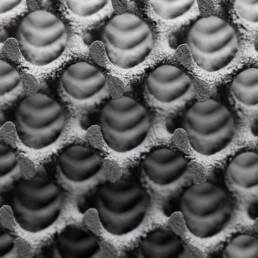
Incredibly high strength-to-weight ratios
One of nature’s blueprints for ultra lightweight, low-density structures is known as the gyroid structure, a continuous network of interwoven helicoidal channels that form a triply periodic minimal surface.
Using this design, SPARTAN structures have incredibly high strength-to-weight ratios, excellent energy absorption capacity, and exceptional resistance to impact and fracture. Different designs are being developed for use in exoskeletons and armor, and to reinforce or protect aircraft, satellites, spacecraft, and more.

Balance, flexibility, and energy absorption
SPARTAN structures have several unique features that make them ideal for aerospace applications. Continuous networks of interwoven channels provide an excellent balance between strength and weight that can distribute loads over a large surface area, reducing the stress concentration at any particular point. The complex structures also provide variable levels of rigidity, meaning they can either be highly resistant to deformation or extremely flexible. SPARTAN structures also provide excellent energy absorption capacity, which makes them highly effective in absorbing the impact of external forces such as vibration, shock, and wind.
Combining two different things: nature's structure and evolution over millions of years, and the power of artificial intelligence.
Originally designed for aerospace and defense applications for satellites, SPARTAN has potential in the energy, civil infrastructure, and safety industries too.