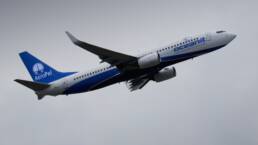
For decades, the aviation industry has been fighting against a potent yet silent enemy: corrosion. When corrosion on an aircraft goes undetected and unrepaired, it can cause the aircraft to disintegrate, often leading to catastrophic accidents. While the industry has established corrosion-preventative treatments, these solutions have limitations, including safety concerns related to their toxic content. Recognizing the perils of corrosion and the existing solutions, Oceanit introduces Aeropel, a Nanocomposite Protective Layer (NPL). NPL offers a clean, innovative solution to combat aircraft corrosion.
Dangers of Corrosion
Corrosion in aviation takes many forms, but generally, it’s the gradual deterioration of metal caused by a chemical reaction with the environment. The surrounding environment could be several things, but common contributing factors include oxygen, water, acids, and salts. The high humidity near coastal areas is also a catalyst for corrosion, making aircraft traveling near the sea more vulnerable.
This was starkly illustrated when Hawaii, known for its high humidity, became the site of one of the most well-known aviation incidents due to corrosion damage: Aloha Airlines Flight 243. In 1998, a 19-year-old Boeing aircraft flying from Hilo to Honolulu suffered a major fuselage tear mid-flight. Despite this, the plane managed a safe landing, but not without one crew fatality and eight serious injuries among passengers.
The U.S. National Transportation Safety Board (NTSB) concluded that the accident was caused by metal fatigue intensified by corrosion. The aircraft, which had flown over 89,000 times, exhibited extensive fatigue cracking and disbanded in its structure. The harsh coastal environment, characterized by high salt and humidity like that of Hawaii, accelerated the wear. Therefore, it significantly shortens the metal’s lifespan – a factor not fully accounted for during testing.
This Aloha Airlines incident served as a wake-up call for many aviation authorities and airline management. Revisions to the aviation industry highlighted the importance of identifying potential issues associated with metal fatigue and corrosion. It also improved maintenance procedures, regular structural inspections, and material testing procedures.
Corrosion can occur at any time on an aged aircraft, and overlooking even a small patch can lead to accidents far worse than the Aloha incident. For instance, China Airlines Flight 611 in 2002 suffered a structural failure mid-flight, killing all 225 people on board. The investigation revealed that a crack made 22 years earlier had amassed numerous fatigue cracks and corrosion around it.
Corrosion Preventative Maintenance
To prevent such disasters, the aviation industry has been coating corrosion prevention treatments on aircraft that repel chemical agents. As of 2023, the industry relies on Corrosion Inhibitor Compounds (CIC). CICs are chemicals that prevent or reduce the impact of corrosion on the exposed metal of an aircraft in harsh environments. The aircraft are coated with CIC inside and out of the aircraft to make a protective film against chemical activity. Chemical activity can come from the air outside the craft and from drinks and spillage inside the cabin.
However, most CICs are chemical-based and highly toxic, posing risks to human and environmental health. They can cause a range of health issues, including organ failures, lung cancers, and permanent damage to the nervous system. Their disposal is also strictly regulated due to the environmental hazards they pose.
Amidst these challenges, Aeropel emerges as a groundbreaking solution, shifting towards a non-toxic and environmentally friendly alternative.
Aeropel NPL, a super-hydrophobic nanotechnology, repels moisture and fluids, preventing corrosion damage even in areas of extreme humidity. It also boasts anti-icing properties, limiting ice nucleation and minimizing snow accumulation. Unlike CIC, most of Aeropel’s product line is water-based, making it safer for applicators and environmentally friendly.
Furthermore, Aeropel aligns with the United States Aviation Climate Action Plan’s goal of net-zero emissions by 2050. Being significantly lighter than CIC, Aeropel reduces fuel requirements and, consequently, carbon emissions. Oceanit’s scientists estimate that Aeropel can save 91 kilograms of CIC on a Boeing 737-800, equivalent to $16,000 of fuel and a reduction of 38,330 kilograms of carbon dioxide. The potential carbon savings across multiple aircraft are substantial.
Economically, AeroPel benefits commercial airlines by extending maintenance cycles and reducing corrosion-related maintenance costs by 75%. Commercial aircraft have maintenance cycles of 4 months, and each time they take this downtime, it impacts operations considerably. On average, the cost
AeroPel represents a significant advancement in aviation safety and environmental stewardship. It offers an effective, non-toxic solution to a longstanding challenge, paving the way for more sustainable air travel, aligning with global climate goals, and providing economic benefits to airlines.
Related News
October 2, 2025
Creating the future of aerospace
Dr. Tsai is a legendary figure whose pioneering breakthroughs in composite materials transformed aerospace…