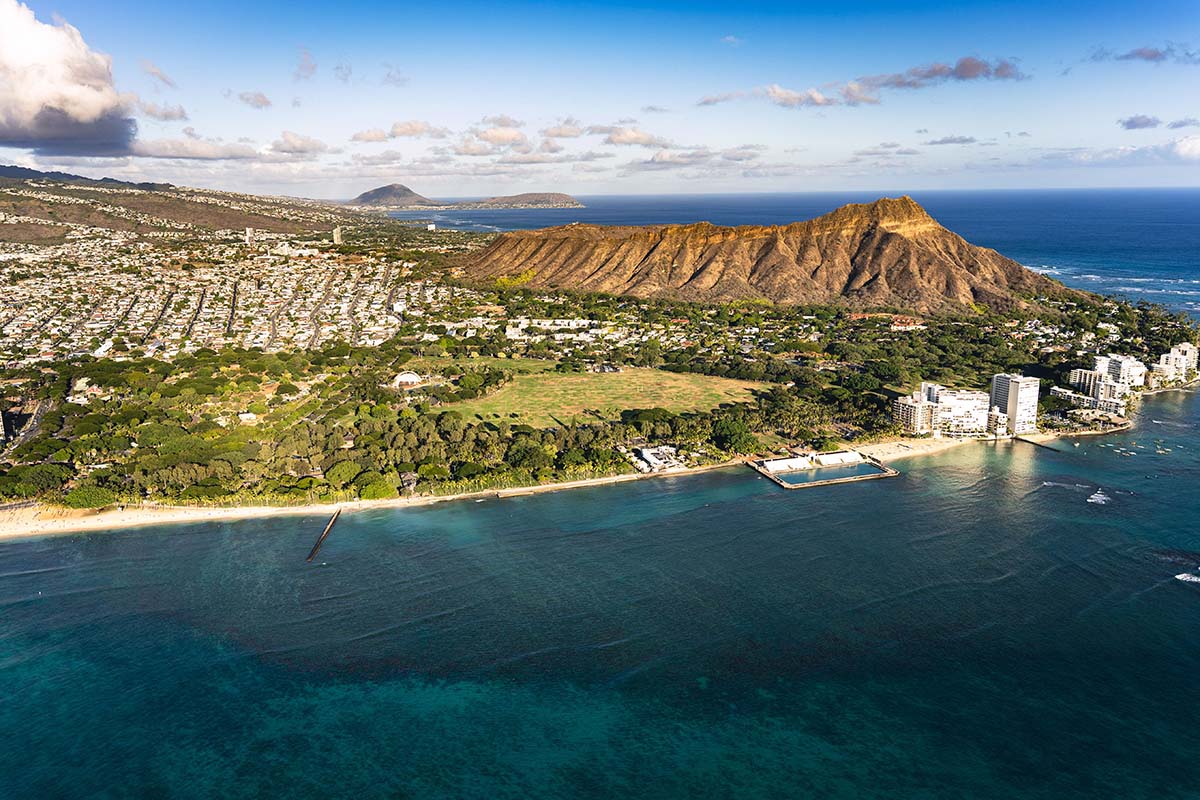

On September 10, the International Union for Conservation of Nature (IUCN) concluded the quadrennial World Conservation Congress with 10,000 participants from nearly 200 countries in attendance. The 10‑day Congress was held in Hawai’i, the first state in the United States to hold the Congress, providing the perfect backdrop to the theme “Planet at the Crossroads.”
Accompanying the IUCN World Conservation Congress was the first-ever Students’ Day. Oceanit partnered with Kupu Hawai’i, Hau’oli Mau Loa Foundation, Kokua Hawai’i Foundation and co-founder Jack Johnson, Punahou School, and the Hawai‘i State Department of Education to hold a Design Thinking workshop dedicated to creating more sustainable schools and local communities. Oceanit helped to educate over 1,000 students who spun out 900 ideas to solve environmental challenges during the session. By the end of the day, hundreds of ideas were narrowed down to one and will be prototyped by the Hawai’i State Department of Education. Along with the Design Thinking workshop, students were able to experience Conservation International’s virtual tour of “Valen’s Reef” using Google’s technology, fold elephant origami to help the Wildlife Conservation Society set a Guinness world record, and view maps of storms and reefs on National Oceanic and Atmospheric Administration’s “Science on a Sphere.”
IUCN Director General, Inger Anderson commented, “some of the world’s greatest minds and dedicated professionals met here at the IUCN Congress to decide on the most urgent action needed to ensure the long-term survival of life on Earth.” More than 100 resolutions and recommendations have been adopted by IUCN members upon concluding the Congress, including one of the most notable relating to climate change—specifically sea level rise. Oceanit’s Dr. Michael Foley added to this discussion by demonstrating the ocean’s detrimental impact on island nations with Oceanit’s Augmented Reality Sandbox (ARS) in his presentation on September 2. Using the ARS, Dr. Foley illustrated how rising waters affect islands over a time span of a few years, submerging coastlines and leaving only inland and tall mountains above the sea level. He went further to explain how the ocean causes natural erosion and what we can do to help restore the shoreline. With roughly 50 people in attendance for Dr. Foley’s segment, he commented saying, “it was a great success in exploring the unique and diverse aspects of what makes a living shoreline in the tropical island environment.”
As a company dedicated to sustainability, Oceanit was proud to have had the opportunity to contribute to the World Conservation Congress. Banding together to create a more sustainable future empowers us to maintain our efforts as we move towards a better planet.
Related News
June 23, 2026
Oceanit recognized at 2026 ACEC Hawaii Engineering Excellence Awards for ʻAliomanu Road project
Oceanit has been recognized by the American Council of Engineering Companies (ACEC) Hawaii at the 2026…
June 12, 2026
High fuel prices can be mitigated by this nanocomposite treatment
Keep Hawaiʻi talent in Hawaiʻi — a statement that a Honolulu-based research and development center continues…
May 11, 2026
Pā‘ia Mantokuji temple given another year to find a fix for erosion threatening Buddhist temple, nearby graves
The cultural landmark of Mantokuji temple is under threat from coastal erosion.