

Altino Scratch: June 1 - Hawaii PDE3 Scratch Course | Trainings for Teachers
What: For 2021-22, we have six PDE3 teacher trainings scheduled for computer science. Learn to code and apply principles of computer science to your classroom.
Why: Computer Science (CS) is a 21st century career choice but more importantly CS is about learning how to think creatively and logically. Also, CS is required in every public high school in Hawaii starting in 2021-22 school year via Act 51. New legislation will bring computer science to elementary and middle schools by 2025.
Who: Designed for K-12 teachers to teach coding. DOE approved for 3 credits. Open statewide.
How: We kick off live online at 8:00am, but most of your training is via self-paced videos and online support from our Altino instructors.
Experience level: No prior computer science or coding experience required.
Size: only 30 teachers per training. Wait list for only 10.
Cost: $0, but if you register and are a “no show”, or you drop without a good reason, you may not be allowed to attend this training again. Based on 3 years of delivering this training, you should budget 50 to 75 hours to learn the materials and to complete your portfolio – three lessons with three student samples per lesson plan. This is a demanding training – if you are awarded 3 credits it’s because you earned it.
Sponsors: Public Schools of Hawaii Foundation, Kamehameha Schools, Oceanit Research Foundation, Toyota Hawaii, Department of Labor.
Contact: Brett Tanaka at OCID
Visit HIDOE's PDE3 website linked below and search 'Altino'.

Interns Wrap Up Summer 2023 at the Oceanit Innovation Summit
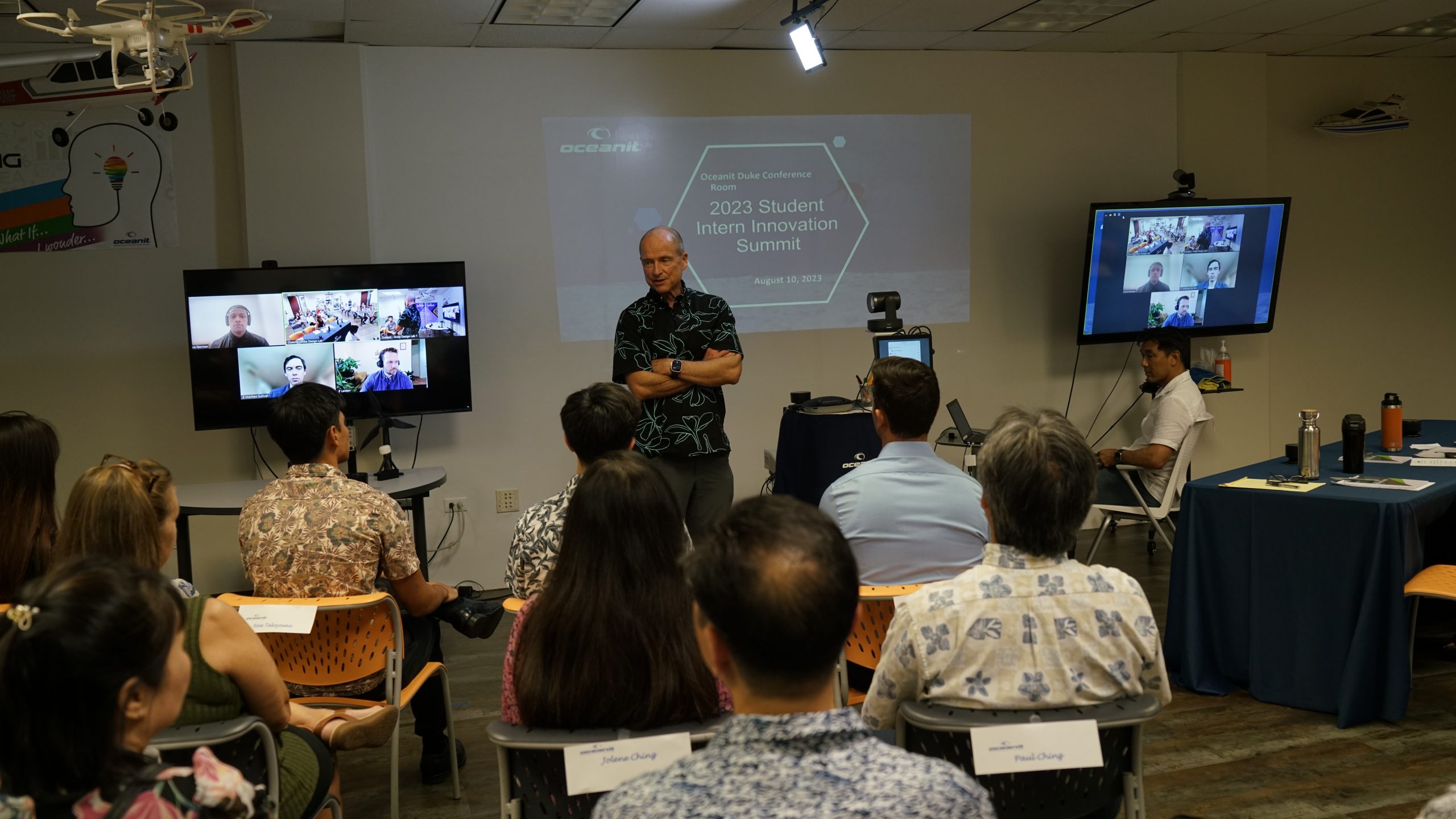
Last week, Oceanit’s 2023 Student Intern Program culminated in the annual Innovation Summit event as the interns presented their final innovation projects to Oceanit leadership, mentors, friends, and family members.
In over 30 years of the Student Intern Program (SIP), Oceanit has mentored more than 600 students at the Ph.D., Masters, and Undergraduate levels, and formerly at the high school level as well. SIP lets student interns apply their academics to ongoing real-world projects, encouraging them to innovate, inspiring creativity and new ideas, and fostering young ambassadors for Hawaii’s technology industry of tomorrow.
Each summer, interns are mentored by and work side-by-side with engineers and scientists on projects for the U.S. Departments of Energy, Transportation, Defense, the State of Hawaii, community organizations and more. They also have weekly exposure to various other departments, to expand their views of how innovative research & development intersects with business, commercialization, marketing, and more.
In addition, each intern is asked to conceive and develop an innovation project – something that they are personally passionate about, that can make the world a better place, and that may align with their academics or career aspirations. The interns identify problems, conduct research, conceptualize solutions and develop prototypes, which builds to the Innovation Summit at the conclusion of the summer program. The interns pitch their innovations to a panel of scientists, engineers and venture capitalists.
Katie Ching is a senior at Santa Clara University, majoring in bioengineering. This summer, Katie prepared and characterized bio-inspired marine inhibition coatings for field deployment studies, developing and optimizing the application process for novel surface treatments on various substrates. She was mentored by Katherine Uttley, Ph.D.
Katie’s innovation project was named CLYDE: an at-home lung cancer screening test. Her innovative diagnostic sought to solve the issue of late detection of cancer development in lung cancer patients. Currently, the only screening test available is an LDCT scan, but CLYDE would take the form of a simple lateral flow assay, which would detect elevated levels of a certain protein that signals the malignant transformation of lung cell nuclei. CLYDE would enable people to do screening tests at home, catching possible cancers earlier.
Christopher Norman is a senior at University of Houston, majoring in computer information systems. This summer, Christopher developed front-end software packages for two Oceanit energy sector products, integrating various back-end software into well-polished, deployable products for field use. He was mentored by Alexander Ventura.
Chris’s innovation project was called REMY: Recipe Enhancing Meal Yielder. REMY is an AI application that combines meal and nutrition planning, grocery shopping/ordering, and an AI cooking assistant. Through user inputs like allergies, dietary needs, location and available local supplies, REMY’s machine learning algorithm would make home cooked meals easier to plan and prepare, in a way that is healthier and more efficient then dining out or the typical home cooked meal. Chris sought to overcome the challenges of ensuring easy access to proper nutrition and health across all age ranges.
Noa Takeyama is a senior at University of San Diego, majoring in mechanical engineering. This summer, Noa designed and fabricated parts, and modified housings for the Oceanit CorLance and ADAPT systems, and also developed the electromechanical joystick control interface that operates Oceanit’s CorLance platform. He was mentored by Patrick Boll.
Noa’s innovation was called AQUA: Acoustic Quest for Underwater Attraction. Noa sought to address the loss of coastal corals and marine life due to factors like infrastructure intrusion, ocean acidification, and tourism and fishing industry infringement. AQUA is a restorative acoustic device that would be powered by wave energy and currents to recreate the sounds of a healthy reef, thereby attracting marine life and coral settlement to increase coral development by 20%.
Giorgio Tran is a Master’s student at the University of Hawaii at Manoa, majoring in computer science. This summer, Giorgio worked on Oceanit’s RIVEAL system, evolving early models into a unified, user-friendly control application. He also designed the storage architecture for data recording, archiving, and retrieval. He was mentored by Dylan Kobayashi, Ph.D.
Giorgio’s innovation was named CROW: Coffee Roasting Optimizing Widget. As a coffee lover, Giorgio wanted to solve the complexities of roasting consistently good coffee, and to produce an ensured balance of sweetness, acidity, and bitterness in each roast. His solution was an edge device which uses AI to perform real-time analysis of coffee in the roasting process via computer vision, first crack detection, and aroma detection. CROW determines when temperatures should be lowered or raised via an AI prediction model to output an optimal roast every time.
Kian La’i Viernes – A senior at University of Hawaii at Manoa, majoring in mechanical engineering. This summer, La’i worked to develop and fabricate a motorized, 3D-printed extendable control for a borescope, as part of the CorLance and Piggyback products. He coded control functions to handle position, speed, and recording functions for a range of visual and IR imaging systems. He was mentored by Matthew Nakatsuka, Ph.D.
Kian’s innovation project introduced a novel device called SURFLOC: Seamless Universal Repair For Locking Out Cracks. As an avid surfer, Kian wanted to improve the expensive and long process of surf board repair by creating an all-in-one handheld surfboard ding repair device. SURFLOC uses a smartphone to take 3D scans of dings or cracks. The scan is input into a resin delivery device which customizes the injection rate and shape of resin into the surfboard. The device would work anywhere, is easy to use, effective, and fast.

11th annual Design Thinking Hawaii Bootcamp Set for June
20 April, 2022 Honolulu, HI | The 11th annual Design Thinking Hawaii Bootcamp is being held online this year, over TWO action packed HALF-DAYS in June.
Over the past 10 years, the Design Thinking Hawaii Bootcamp has taught hundreds of students, teachers, and educators about the process of Design Thinking innovation. Sponsored by the Public Schools of Hawaii Foundation and hosted by Oceanit’s Stanford d.school facilitators, the 11th annual event will be held virtually on June 16-17. Each day will feature a half-day of human-centered, team-based design learning. The Bootcamp is free for Hawaii public school educators and students!
Design Thinking is a term that was coined as a response to the open question of ‘what design had to contribute to the modern world’. More recently, Design Thinking has been coupled to “wicked problems”—problems that are complex, open-ended, and ambiguous. Stanford’s d.school developed Design Thinking into an iterative process, that teams can use to understand users, challenge assumptions, redefine problems and create innovative solutions to prototype and test. Involving five phases—Empathize, Define, Ideate, Prototype and Test— Design Thinking has been widely adopted to tackle problems that are ill-defined or unknown, these “wicked problems”.
Oceanit’s Ian Kitjima will join Hawaii Public Radio’s Bytemarks Cafe show at 6:30pm on Wednesday, April 20th to talk about Design Thinking in Hawaii and the 11th annual Bootcamp.
Day one of the Bootcamp will run from 8:00am – 1:00pm on June 16 , and day two is 8:00am – 12:00pm on June 17 (Hawaii Standard Time). The sessions are specifically designed for people who are new to Design Thinking, or those who are a bit rusty and want a refresher. Attendance via Zoom will be limited to 200 (with 50 seats for non-educational attendees). Teachers and students will be granted priority, but everyone who is interested to learn the process and mindset of innovation is welcome.
To learn more and register, please visit our Eventbrite page: https://bit.ly/3KbtB4y

Altino Intro SCRATCH: March 18 - Introduction "SCRATCH" workshop for teachers and parents
Aloha Hawaii teachers! Join us for a hands-on hybrid SCRATCH workshop to expose you and your students to another world.
Aloha! Please join us for a 2 hour hands-on workshop to expose yourself to elements of computer science, coding, and how you can use the Altino car (real/physical) to make subjects engaging and fun tomorrow. NOTE: for SCRATCH programming we do not have virtual car so we are planning an in-person workshop for those on Oahu, while doing an online session for those on the neighbor island who have access to Altino cars. Every island has a pool of Altino cars.
Prerequisite: None. This workshop is for non-technical teachers who have no coding experience, and for existing Altino teachers who want to learn SCRATCH, a visual programming language. We will have a separate setup day to get your computer and Altino car working together.
What to Bring: A PC laptop (not Chromebooks) so we can load a special version of SCRATCH that is customized for Altino. For neighbor island teachers, you will need to be able to join us via Zoom.
Instructor: Terry Holck
Location: Hybrid. A physical location on Oahu, and online via Zoom for neighbor island teachers. A Zoom link will be sent prior to the start of the workshop
If you have any questions, please contact Ian Kitajima, [email protected] or 808-531-3017, or Terry Holck, [email protected].
For more information about Altino visit Oceanit Research Foundation at the Organizer website link below!
Altino Intro C: March 16 - Introduction "C" workshop for teachers and parents
Aloha Hawaii teachers and parents! Join us online on March 16th from 9:00-11:00 am for a virtual Altino coding workshop. We'll be using the new Altino virtual car to expose you and your students to another world.
Please join us for a 2-hour, virtual workshop to expose yourself to elements of computer science, coding, and how you can use the Altino car (virtual and real) to make subjects engaging and fun tomorrow. Click the website link beneath "DETAILS" below.
Prerequisite: None. This workshop is for non-technical teachers who have no coding experience, and for existing Altino teachers who want to learn about the virtual car.
What to Bring: If you can join us via Zoom, you probably have everything you need, i.e., an internet connection and a web-browser.
Instructor: Stephanie Mew
Location: Online via Zoom. A Zoom link will be sent prior to the start of the workshop
If you have any questions, please contact Ian Kitajima, [email protected] or 808-531-3017, or Stephanie Mew, [email protected].
For more information about Altino visit the Oceanit Research Foundation website in the organizer link below.

IN THE NEWS | Oceanit IT Director David Takeyama on HPR
Oceanit’s Head of IT, David Takeyama, spoke with
“Skills that we’re looking for are things like networking system administration. Things like configuring firewalls or routers,” Takeyama said. “And then there’s cyber analytics. So this could be log management and knowledge of how to analyze an incident. So it’s important to know a real threat versus not a real threat.”
Oceanit has been searching for the right fit for over a year. A recent study by SMS Hawaiʻi found that in 2020 there were nearly 13,000 job openings in the Hawaii tech sector — in IT, cybersecurity, networking, etc. — but only 3,800 people hired. As a result, the Chamber of Commerce Hawaiʻi, in partnership with The University of Hawai’i, announced a new program called “Leap-Start”. The new effort will connect employers and students with IT work opportunities in the hopes that Hawai’i can establish a competitive pipeline and tech workforce.
Read the full article and listen to HPR’s broadcast segment here.

Ian Kitajima Talks Innovation in Education with What School Could Be
On Thursday, January 20th, Oceanit’s Ian Kitajima joined hosts Susannah Johnson and Kapono Ciotti for a What School Could Be “Game Changer Series” livestream discussion. For one hour, Kitajima spoke to an audience of some of education’s biggest changemakers on how he got into education, what it takes to be an innovator, how teachers can start using innovative approaches in the classroom, and what students could do to be “future-ready.”
As Oceanit’s Tech Sherpa, Ian has an inside perspective on the opportunities and potential in technology innovation and believes it’s incredibly important that Hawaiʻi’s students are equipped for a future shaped by artificial intelligence and computer science. After all, he argues, the innovative companies of the future don’t yet exist—they’ll be founded by today’s students, and the best thing we can do to prepare them is to get them engaged with technology and spark their interest now.
To reach the greatest number of students, Ian has focused on first reaching teachers. For the last decade, he has worked tirelessly to empower the community to think innovatively and create the future via Design Thinking and coding. To date, over 10,000 Hawaiʻi educators and industry professionals have gone through Oceanit’s Design Thinking workshops, and Ian is well on his way to reaching the goal of training 5,000 non-technical teachers how to code using Altino programmable cars.
Responding to questions from the livestream audience, Ian discussed fostering innovation in education at length, identifying things teachers can do to encourage innovative thinking, including cultivating a culture of experimentation, providing the room for failure – where it is expected and accepted, making learning experiences that students want versus trying to make students want to learn, and collaborating with people outside education.

What Schools Could Be -- Game Changer Series: A Conversation with Ian Kitajima
Join What Schools Could Be for a Game Changer Series conversation with Oceanit's Director of Corporate Development, Ian Kitajima. Ian is best known as the “Technology Sherpa” at Oceanit – a “Mind to Market” innovation lab of 160 scientists, engineers, technologists, designers, and dreamers conducting advance technology development research for government and private clients worldwide.
On Thursday, January 20, from 2:00 PM – 3:00 PM HST (7:00 PM Eastern), Ian will join host Ted Dintersmith to talk about Oceanit's SURF program and educational initiatives focused on bringing innovation, computer science, coding, and Design Thinking to our schools. Oceanit's SURF program is focused on empowering students and educators with new super powers for the future. RSVP by clicking the Eventbrite link below!
As Oceanit's Technology Sherpa, his role is to move science and technology breakthroughs from the lab to the marketplace, which has included opening the South Korean market since 2014, and 3 venture backed Oceanit startups as a co-founder at Hoana Medical, Nanopoint, and Ibis Networks. He is the co-founder of the Design Thinking Hawaii movement beginning in 2010, the "Altino" movement in 2017 to teach 5000 non-technical teachers creative problem solving skills via computer programming so every student in Hawaii can be exposed to Computer Science, and the Aloha AI Network in 2019 to put the future of Artificial Intelligence into the hands of teachers and students now.

2021: An Oceanit Action-Packed Year in Review
No phrase sums up 2021 better than CEO Patrick Sullivan’s Monday morning greeting, “Welcome to another action-packed week at Oceanit.”
2021 was truly 52 weeks of non-stop action at Oceanit. Perhaps even more than usual—and definitely in spite of the ongoing global pandemic. Our teams were firing on all cylinders, working across a range of disruptive ideas, programs, projects, and products.
In the past year, Oceanit grew, adding 21 new hires to the ʻOhana, and welcoming 2 new babies in our extended ‘Ohana. Oceanit’s Houston team doubled in size, adding critical new personnel to support pilot scale productions and field deployments for our technologies. The Houston team sits near a nexus of partners in sectors as diverse as energy, biomedical, aerospace, petrochemicals, and more.
Oceanit also opened a new office at Honolulu’s Daniel K. Inouye International Airport to aid ongoing projects with the Hawaii Department of Transportation’s (HDOT) Airports Division. The team is hoping to expand our work with HDOT in 2022 as we partner to address the state’s aging infrastructure.

We were awarded more than 25 new projects from federal, state, and local clients and partners across a wide spectrum of disciplines including hydrogen fuel development, carbon sequestration, Artificial Intelligence, coastal engineering & sea level rise, and much more. The team also commercialized three new products, mind to market technologies born of the disruptive research and development that happens every day in our labs and scale-up workshops.
Oceanit’s SURF program launched new intern program partnerships with the Hawaii Department of Transportation, Highways Division, to utilize AI in improving safety along Farrington Highway, and began a partnership with the Hawaii State Public Library system to implement AI across the state’s libraries with the help of students from Hawaii Public Schools.
The SURF team also held 6 Altino Coding workshops for educators, continuing the work of spreading computer science to teachers and educators across the state. Oceanit participated in 5 Hawaii Book & Music Festival panels and presentations, and held 4 Design Thinking workshops, including the 10th annual Design Thinking Hawaii Bootcamp. Oceanit was also proud to launch an underwriting partnership with Hawaii Public Radio, supporting the National Public Radio Science Friday show.
ASSURE-100
Throughout 2021, the ASSURE development team worked tirelessly on trialing and improving our rapid COVID-19 test, ASSURE-100, which was recently submitted to the U.S. FDA for emergency use authorization (EUA). The ASSURE-100 test is a simple, fast, accurate, and affordable Lateral Flow Assay (LFA) developed completely in Hawai’i. Even with the effectiveness and availability of COVID-19 vaccines, testing will remain vital to monitoring transmissibility of new variants
HeatX
HeatX made huge progress in 2021, being deployed in multiple countries around the world. Our Advanced Materials team published the promising results of a pilot deployment in partnership with Italian energy company ENI, which analyzed HeatX’s efficacy at their refinery in northern Alaska. The results were debuted at ADIPEC event in Abu Dhabi this past November. Eni data showed that if applied facility-wide, savings in supplemental heating emissions would reducing carbon emissions by up to 17,000 tons annually in the pilot facility alone.

EverPel protecting community art
Oceanit worked with local artist Solomon Enos to apply Grafix to a community mural in Kaimuki. Grafix is a formulation of our EverPel coating, designed to make it easier to remove graffiti from treated surfaces. We hope this will be the first of many collaborations with Enos as he aims to create more community-owned art across the island.
IoView
Oceanit expanded our work in Computer Vision AI and Machine Learning, adding projects to utilize AI to examine plant roots for crop health and to analyze aviators’ vision and retinal health following laser exposure. Oceanit also completed a project with the Department of Homeland Security, ʻIoView, which is now moving towards commercialization. ʻIoView is a computer vision platform developed to process imagery in the wake of natural and man-made disasters and improve utility grid response times and recovery.
HNL Airport Projects
Oceanit has been hard at work on several projects with the State of Hawaii Department of Transportation, Airports Division. In 2021, the team completed a project to remove invasive mangroves from Keʻehi Lagoon, preventing potentially dangerous bird strikes to aircraft departing HNL. The invasive mangroves created unnatural bird habitats for a variety of species. Oceanit is currently working with the Daniel K. Inouye Airport on two additional projects to improve aging infrastructure at the airport—overseeing the replacement of old, asbestos-containing construction materials and designing a solution to water infiltration issues that have persistently flooded the airport basement where baggage is handled. To facilitate this work, the RiSE Team opened an on-site office at HNL as a forward HQ for the two projects.

Coastal Erosion & Shoreline Protection Projects
Sea level rise and the subsequent coastal erosion is fast becoming one of the most pressing issues for coastal communities, around the world.
In 2021, our RiSE team wrapped up a two-decade long shoreline resilience project at Mauna Lahilahi Beach Park, designing a breakwater to reduce wave energy, prevent erosion, and protect the Mākaha Surfside Apartments and beach park. For more than 50 years, the beach and shoreline at Mauna Lahilahi Beach Park in Wai’anae, had been eroding due to sea level rise. All of the beach sand and some of the back shore substrate were lost along a 350-foot shoreline cove during the previous decades. The final revetment and greenway worked on by Oceanit reconnected the beach park into a single, traversable park once more.
The team also completed work on the Queen’s Beach Seawall in Waikiki, engineering not just to protect structural integrity but also to preserve the historic wall. The wall sits between Kapahulu Avenue and the War Memorial Natatorium, running along the shoreline paralleling Kalakaua Avenue. Oceanit provided planning, design, permitting, and post-design services for this historic Waikiki seawall section, which is approximately 500-foot-long and was severely eroded.
Blast Ninja Quiet Blasting Nozzles
Oceanit’s quiet blast nozzle, Blast Ninja, went into production in early 2021, and the team has seen great success, with orders shipping around the world. Our engineers leveraged years of aero-acoustic research for jet engine noise reduction to design an abrasive blast nozzle that reduces nozzle air exit velocity while maintaining particle velocity, thereby reducing noise at the source, yet maintaining blasting production.
The Blast Ninja Quiet Nozzle reduces sound energy produced by 50% or more versus regular nozzles. Originally developed with the US Navy, Blast Ninja is quickly becoming a new industry standard.
AeroPel
Continuing to push the boundaries on industries that can benefit from our nanocomposite surface treatments, AeroPel Nanocomposite Protective Layer (NPL) was commercialized in 2021. Oceanit applied AeroPel to helicopter rotors to see whether it could prevent blade erosion and reduce the need for repainting. More pilot deployments are in store in the near future for the family of AeroPel variants that the team is developing.
19°N Honu Cooling Pack
Adapting a wearable cooling technology that we originally developed for the Navy, the Commercialization Team successfully ran a Kickstarter campaign for a cooling vest redesigned for outdoor recreation users. The Honu Cooling Pack was launched under the brand name 19°N and marks our first steps into the general consumer sphere. The new outdoor gear brand will be shipping our first units to customers in 2022 and the team couldn’t be more excited for what lies ahead!

Powering National Competitiveness Through Disruptive Innovation: Patrick Sullivan Delivers Keynote Address to Universities Across the US
Olympic Valley, CA. 28 September 2021 | Oceanit Founder & CEO, Dr. Patrick Sullivan, delivered the keynote address to attendees from 112 land-grant universities around the US — representing an impressive cross section of notable institutions including Cornell, Purdue, University of California (Berkeley, UCLA, UCSD) and The University of Hawai’i.
Participation was broad and included representation from every State and Territory in the US, University Deans from Colleges of Life Sciences, Environmental and Natural Sciences, and Agriculture, plus several University Presidents, including Dr. Michael Drake, who oversees California’s world-renowned university system of 10 campuses, five medical centers, three nationally affiliated labs, and over 280,000 students.
The 2021 Experiment Station Section (ESS) annual meeting focused on “Disruptive Innovation,” as these academic, industrial, and workforce-building institutions consider how to compete in the new industrial revolution — the emerging global competition in technology, jobs, food, environment, agriculture, climate, and more. Their collective mission is a fitting evolution to the program originally created in 1862, signed off by President Abraham Lincoln, as the US was in the middle of the Civil War – a war fought during the advent of machines, like the steam engine, that were sweeping across Europe and the US, where machine labor displaced human labor, creating economic winners and losers.
Today, there is a similar global economic competition occurring as artificial intelligence displaces humans and transforms industries, manufacturing, medicine, defense, and the workforce. These land-grant Universities built the industrial might of the US back in the last century and are dedicated to doing the same today and for the future.
Dr. Sullivan’s keynote titled, “No-Boundary Thinking and the use of Transdisciplinary, Diverse Teams,” was moderated by Dr. Susan Duncan of Virginia Tech, VAES Associate Director. Dr. Sullivan reviewed how to begin thinking of disruptive innovation by asking fundamental questions – discerning what is “interesting and important,” rather than focus on “requirements-based” considerations.
All attendees received a copy of Dr. Sullivan’s recent book, Intellectual Anarchy: The Art of Disruptive Innovation.
“(I) loved Intellectual Anarchy and it’s recipe for creating disruptive innovation. It addresses a complex strategy in a clear, entertaining style using compelling examples from the author’s first-hand experiences. In short, Patrick delivers a master class in disruptive innovation and in doing so, creates the opportunity to be amazing. Patrick is at the nexus of all the (Disruptive Innovation) conversations. He has identified the attributes of innovation (or techno) warriors, he has reflected on the manufacturing nature of higher ed. turning out graduates with advanced degrees, and he employs diverse, transdisciplinary teams to solve problems.”
Dr. Richard C. Rhodes III, event committee organizer, University of Rhode Island, Executive Director of NERA
“(I was) really inspired by Intellectual Anarchy and how it articulates a refreshing process for disruptive innovation – from basic science to products. It lays out a practical framework for our university members and researchers to explore and emulate, particularly as they pursue high risk, high impact ideas, as well as the community engagement needed to bring these ideas to everyday life.”
Dr. Bret Hess, University of Nevada, Reno, Event Chair, Executive Director of WAAESD
“Disruption is often viewed as a negative concept and ‘expert’ as the power position for innovation and knowledge, but the book, Intellectual Anarchy – the Art of Disruptive Innovation, changes this paradigm. I’m using this book as my GPS to disrupt our academic mindset and traditions and reimagine the culture of innovation, exploration, and risk-taking in Virginia Tech’s Center for Advanced Innovation in Agriculture.”
Dr. Susan E. Duncan, Virginia Tech University, Director of CAIA